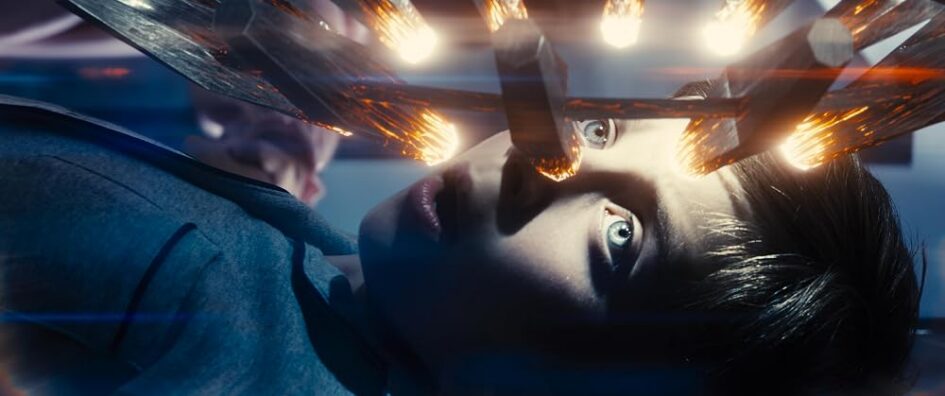
Growing up a Child of the ’80s, the mere mention of Steven Spielberg immediately meant two things to me: His successful creation of E.T. The Extra-Terrestrial — it was everywhere in pop culture back then — and his collaboration with George Lucas in building the Indiana Jones film franchise. Not long afterward, I would recognize the brilliance of Jaws and Close Encounters of the Third Kind (and much later Jurassic Park and Schindler’s List, among others) as I grew older. The filmmaker helped build my love for science fiction, which continues to this day.
As my interest in the paranormal world increased, I gravitated toward those types of stories. And the vague announcement of Disclosure Day, before I knew anything about the feature film, felt like an automatic home run from the Hall of Fame filmmaker.
But when the movie was released on June 12th, it received mixed to negative reviews. Watching its box office results, it was no sure-fire hit from the successful director. Why were so many people hating on this film?
These days, Spielberg’s high-concept films tend to attract an older audience, who have come to appreciate his work. Without going out of my way to watch the trailers for Disclosure Day — which tend to spoil entire films, these days — I took a chance to watch the film on a hot summer day (movie theaters are great escapes to air-conditioned goodness) without knowing any details. As I collected myself and wrote a few notes while the end credits rolled, I felt something strange.
I had just witnessed the ole Spielberg Switcheroo.

What was promoted as a possible paranormal epic was actually… a heist film? Specifically, it’s a heist flick disguised as an alien invasion story.
In this film, two random characters have been experiencing a strangeness… even though they can’t actually remember their side effects. Meteorologist Margaret Fairchild (portrayed by Emily Blunt) and cybersecurity specialist Daniel Kellner (Josh O’Connor) have been imbued an unknown power: she’s somehow received psychic abilities, and he now intimately understands the language of the universe (mathematics). Together, their history betrays them as they threaten to reveal the modern-day presence of UFOs and their alien counterparts.
Much like E.T., humanity plays both the protagonist and the antagonist. But unlike that film, Disclosure Day is more focused on corporate thieves becoming whistleblowers for the greater good, as Big Brother and Big Tech attempts to suppress almost 70 years of information from the general public. This becomes a never-ending chase scene of whoever has the McGuffin device actually controls the future — not exactly a Spielberg storyline staple. Used conservatively, it paces the film’s progress. Instead, the script switches from a slow-burn character development to nonstop chase scenes while revealing very little of the aliens until the final scenes.
Opening in the U.S. at $44 million, the film slowly built an audience, while flashier films premiered and disappeared — that’s the lasting power of Spielberg. It would go on to bank $111 million domestically and $229 million worldwide, so it’s technically not a flop, but it definitely underperformed.
Disclosure Day should be remembered for what seems to be the final composition of John Williams (his 30th collaboration with Spielberg!) and Blunt’s powerful performance. But it also presents a little too-positive assumption by Spielberg, that aliens only have peaceful plans for humanity, overlooking decades’ worth of real-life abductions, probes and physical evidence pointing to the contrary.
There’s also an alien actually wearing a sweater! Don’t miss it!
The slow-burn of the script and the theme of DD heavily reminded me of Arrival, which I enjoyed much more. So, is this Spielberg’s veiled attempt at copying Denis Villeneuve? Maybe. But his previous released material states otherwise. Regardless, I’d prefer to see the filmmaker tackle more conspiracy-themed topics aimed at results that don’t involve aliens.
Or, at the very least, films that DON’T use the Spielberg Switcheroo.