There are times when I have a very clear idea in my head of what I want to say… and then the second I open my mouth it comes out completely wrong. Not just a little off, either. I mean way off. Like I’ll start telling a story, thinking I’m about to land this clever, well-structured point, and somewhere along the way I take a hard left turn into nonsense land. By the time I get to the end, I’m looking at the person I’m talking to, they’re looking back at me, and we both know I did not stick the landing.
The intent was there. The execution? Not so much.
And the worst part is, in my head, it made perfect sense. All the pieces were there. I just couldn’t quite connect them in a way that translated to anyone else. It’s frustrating, because I know there’s something good in there… it just never fully comes together the way you hoped.
That feeling kept creeping back into my mind while watching The Infinite Husk.
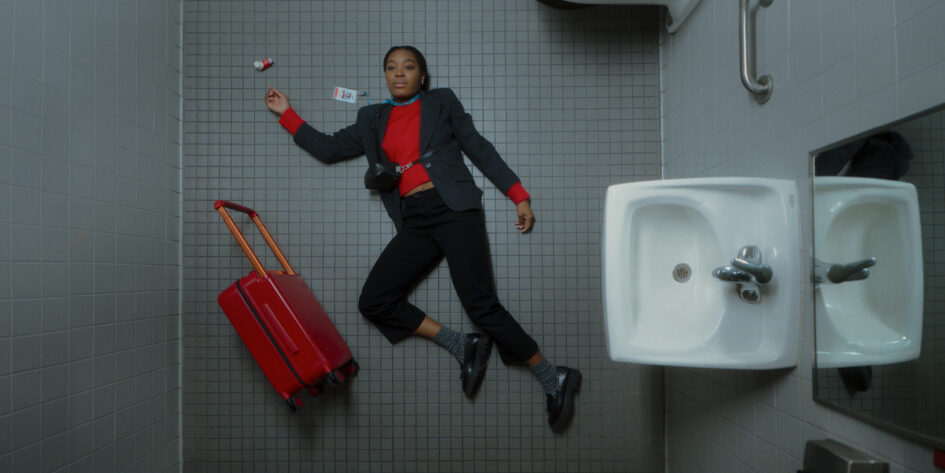
The Infinite Husk marks the feature debut of Aaron Silverstein. The story follows Vel (Peace Ikediuba), a non-corporeal alien consciousness forced into the body of a recently deceased human, referred to as a “husk.” Sent to Earth to atone for some crime, her mission is to locate another exile, Mauro (Circus-Szalewski), who has spent centuries jumping from one husk to another.
Whatever Mauro has been working on has caught the attention of those back home, and Vel has been tasked with finding him, uncovering his intentions and reporting back.
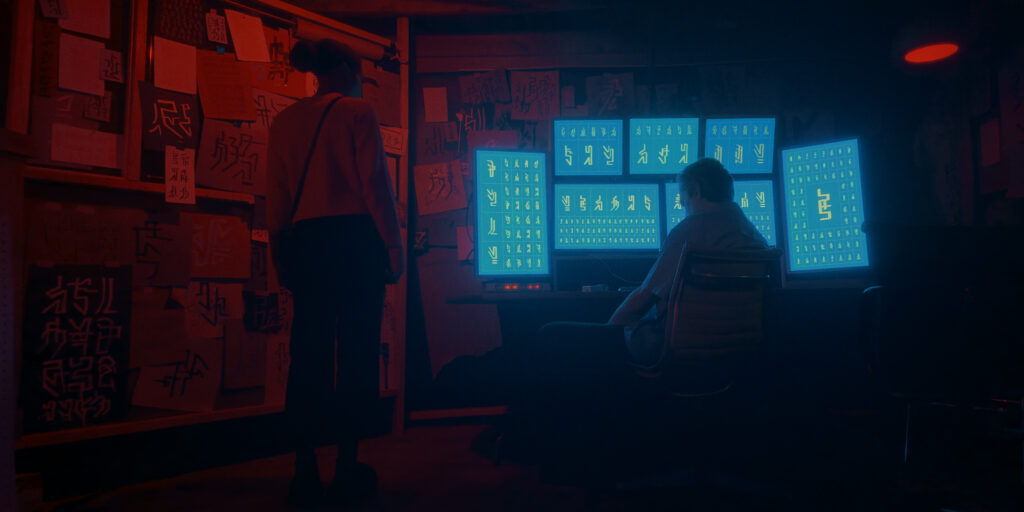
First and foremost, this is a beautifully shot movie. For a debut feature, Silverstein shows a really strong visual eye and a clear understanding of how to frame a scene in a way that draws you in. There’s a deliberate, almost patient approach to the cinematography, where shots are allowed to breathe instead of being rushed from one beat to the next.
What stood out to me most is how much intention there is behind the camera. The compositions feel purposeful, whether it’s isolating Vel within the frame to emphasize her detachment from everyone else, or using negative space to make even ordinary locations feel slightly off. Lighting plays a big role as well, giving the film a grounded, natural look while still maintaining an undercurrent of unease. It never feels over-stylized, but it also never feels flat.
Another major strength of the film is Ikediuba as Vel, delivering a performance that fully convinces you this is not a human mind behind those eyes. She carries herself with a deliberate detachment, playing the role as an alien observing and studying rather than truly engaging, while also subtly showing the struggle of adapting to a corporeal body and its limitations. It’s controlled, intentional and never overplayed, making her a compelling presence even when the film, itself, begins to drift.
Where the film stumbles is how it conveys its story and themes.
It often feels like Silverstein has a clear idea of what he wants to say but struggles to fully communicate it. The film leans heavily into the idea that humans are cruel, violent and driven by prejudice, yet both Vel and Mauro, who present themselves as curious and research-driven beings, show very little actual curiosity about the world around them.
Instead of exploring humanity, they seem to judge it almost immediately, forming conclusions based on limited, negative interactions, which makes their perspective feel more assumed than earned. What makes this more frustrating is that the film, itself, acknowledges through Vel’s narration, that hostility and betrayal are not inherent to humanity. But it never really follows through on that idea.
Nearly every interaction Vel has reinforces the same bleak outlook, creating a world that feels overwhelmingly one-note in its pessimism. We never get that moment of kindness showing what humanity is capable of, beyond cruelty. Without that contrast, the film’s message feels less like a thoughtful exploration and more like a preachy conclusion it never tries to challenge.
In the end, I land at three out of five stars for The Infinite Husk. Silverstein clearly understands that visuals can do just as much storytelling as dialogue, and in many cases here, they are doing the heavy lifting. Even when the narrative starts to drift, the film remains engaging on a visual level, which is no small feat.
Pair that with a strong, committed performance from Ikediuba, and there is a lot here to appreciate. At the same time, the film never quite connects all of its ideas, especially when it comes to fully exploring the themes it introduces, leaving it feeling more distant than it probably intends.
And this brings me back to that initial feeling: The intent is clearly there. You can see the pieces, the ideas and the ambition behind it all. But somewhere along the way, it just does not fully come together. Still, this is a debut that shows real promise, and it makes me genuinely curious to see what Silverstein does next when those ideas and execution line up just a little bit better.