I grew up reading comics for the same reason most people do: escapism. You get to live life through the eyes and actions of a superhero. Batman takes down criminals with precision and wit. Spider-Man quips his way through impossible odds. The Avengers save the world before dinner. In some ways, you fantasize about it, thinking how cool it would be to wear that suit, punch that villain, save that city.
The comic book fantasy isn’t just entertainment. It’s permission to imagine yourself as someone braver, stronger, more capable than you actually are.
Those dreams are fine when they stay dreams. When you close the comic book and return to your actual life, the magic fades, but it doesn’t hurt. But what happens if they don’t? What happens when the line between the fantasy and reality starts to blur? What happens when someone stops reading about heroes and starts believing they are one? Or worse, that they are something else entirely?
Aaron Sherry’s Captain Tsunami asks these questions with devastating clarity, exploring not just the power of comic books to inspire, but their power to destroy.
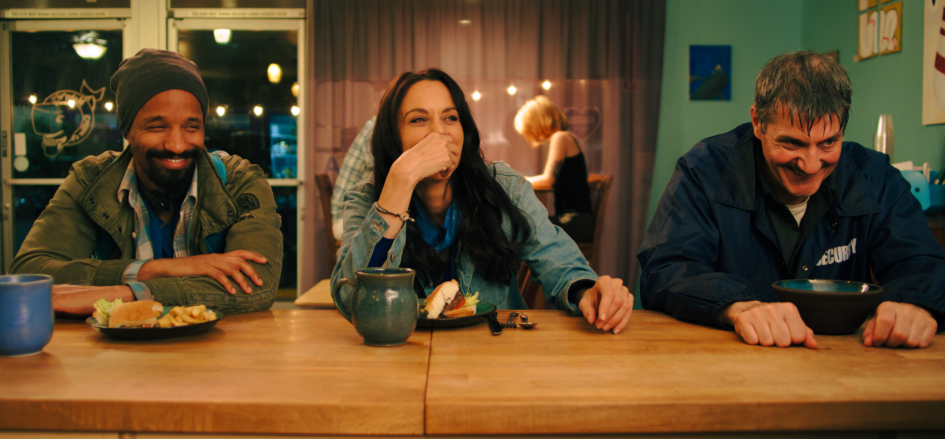
In the film, Glenn (P.J. Marino) owns a small comic book shop, a quiet sanctuary he’s built for himself over the years. When a 12-year-old girl named Emma (Madeleine McGraw) shows up at his door with a backpack full of unfinished storyboard pages, his carefully constructed isolation begins to crack.
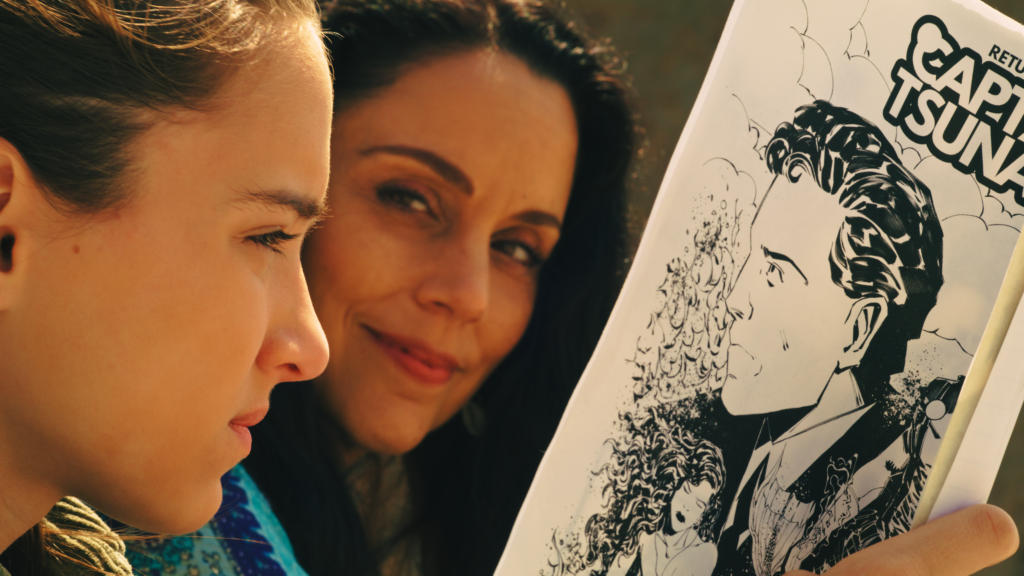
The pages are a comic book drawn by Emma’s mother, Desiree (Tessa Munro), a woman Glenn once was close friends with and loved. Desiree has disappeared. As Glenn begins to decipher Desiree’s fragmented narrative, he’s forced to confront his past with her. The story that unfolds is entirely about what it means when the stories we tell ourselves to escape the real world become the stories that consume us.
Films about mental illness and family trauma walk a dangerous tightrope. Get it wrong, and you end up turning suffering into spectacle. Get it right, and you create something that honors the complexity of living with someone whose mind works differently than yours, the burden it places on loved ones and the way trauma affects friends and family.
The best films in this space don’t offer easy answers or redemptive arcs where medication and therapy fix everything. They sit with the discomfort. They ask hard questions about responsibility, loyalty and whether love is enough when someone is drowning in their own false reality.
Captain Tsunami understands this assignment. Aaron Sherry doesn’t shy away from depicting Desiree’s neurodivergence and the way her psychosis fractures her relationships. But he also refuses to reduce her to her illness. She is a mother. A creator. A person trying to communicate something true even when her grip on reality is slipping.
What makes Captain Tsunami work is its refusal to let Glenn off the hook. P.J. Marino plays him as a man drowning in quiet guilt. A security guard-turned-comic-shop owner who has built an entire life around avoiding the people he once loved. Glenn, Malcolm and Desiree grew up together, bound by their orphanhood. They had something real. Something that mattered.
But Glenn pulled away after events occurred. He chose isolation over presence and that choice had consequences. Malcolm (Craig Frank) stepped into the role Glenn abandoned, being there for both Desiree and her daughter. Desiree paid the highest price for Glenn’s absence. The film doesn’t paint Glenn as a villain. It paints him as a man who was so focused on his own survival that he couldn’t see how his withdrawal was pulling others under. That’s a far more interesting tragedy than simple cruelty.
What’s equally impressive is how Sherry structures the reveal of the past.
Rather than a linear backstory delivered, the film fragments its history the way Desiree’s comic book pages are fragmented. We learn about Glenn’s trauma. Malcolm and Desiree’s struggles. The role Glenn played in their lives. Not in neat chronological order, but in jumbled pieces that the audience has to piece together, just as Glenn has to piece together Desiree’s unfinished narrative.
It’s a formal choice that could have felt gimmicky, but here it works because it mirrors the disorientation of trauma itself and the way our minds don’t process painful events in sequence, but rather in fragments and flashes and sudden recollections that hit us sideways.
By making the audience work to understand the past, Sherry immerses us in Glenn’s experience. We’re not watching his story unfold cleanly. We’re experiencing the confusion and incompleteness of memory the way he does. It’s a small thing, but it’s the kind of attention to form that elevates the entire film.
If there’s a weakness in Captain Tsunami, it’s that the ending feels incomplete in a way that doesn’t quite justify itself. Glenn and Malcolm reconcile and become co-fathers to Emma, but the film rushes through this resolution as if afraid to sit with what it actually means. How do they rebuild trust? What does “being a father” look like for Glenn?
The film seems to suggest that showing up is enough, and while that’s thematically resonant with its exploration of presence and absence, it leaves too many threads dangling.
There’s an argument to be made that this mirrors Desiree’s unfinished comic book, that incompleteness is the point. But there’s a difference between intentional ambiguity and narrative shorthand. The former invites reflection, the latter feels like the film ran out of time or courage to fully explore what redemption actually costs these characters. It’s a minor stumble in an otherwise thoughtful film, but it’s a stumble, nonetheless.
I give Captain Tsunami five out of five stars.
It’s a film that understands the power of comics to both save us and destroy us, a meditation on the men we fail to become and the people we finally choose to be. When I read comics, I understand that space as a refuge, a place where people could escape into worlds larger than their own. Captain Tsunami reminds us that escape is necessary, but it’s also dangerous.
The film doesn’t condemn Desiree for losing herself in fantasy. It mourns her. It asks Glenn, Anna and Malcolm and the audience to reckon with what we owe the people we love when their grip on reality starts to slip. Aaron Sherry has made something rare, a small indie film that refuses easy answers and insists on the messy complexity of trying to love someone who is drowning.
The ending may leave you wanting more closure, but the journey to get there is worth taking.