I’ve spent nearly 20 years working in haunted attractions, and if there’s one thing I’ve learned, it’s that the magic of a good haunt happens when the lights go out. During the day, those terrifying monsters are usually nothing more than foam, latex, plywood and a generous amount of imagination.
That horrifying creature lurking in the corner? Probably a mannequin held together with zip ties. The blood-soaked walls? A little paint and some creative decorating. But throw in some fog, carefully placed lighting and a few enthusiastic actors, and suddenly those cheap decorations become something that can send grown adults screaming for the exit. It’s an art form, and one I’ve always had a tremendous appreciation for.
Of course, working in a haunted attraction isn’t nearly as glamorous as it might sound. I still remember those long nights at Monster Mountain, when we’d spend hours scaring customers before finally gathering for our reward: Domino’s pizza. There’s nothing quite like enjoying a slice of pepperoni that’s been seasoned with sweat, body paint and whatever Pros-Aide adhesive happened to be stuck to your fingers. It probably wasn’t the most sanitary meal in the world, but after several hours of chasing screaming teenagers through the woods, it tasted like a five-star dinner.
Those memories are part of why I’m always interested when a horror movie takes place inside a working haunted attraction. Unfortunately, Hellbilly Hollow reminded me that sometimes the scariest thing about a haunt isn’t what’s lurking in the darkness. Sometimes it’s the storytelling.
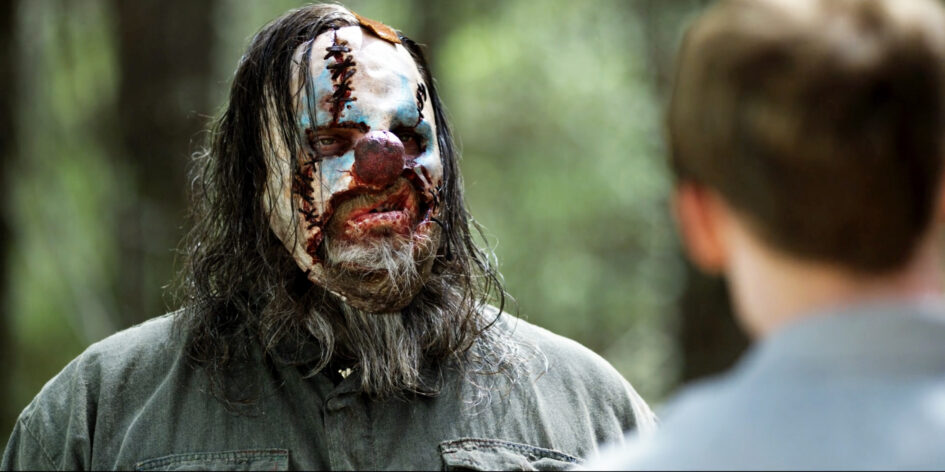
Hellbilly Hollow takes place at a rural haunted attraction operated by a man named Bull (Kurt Deimer) and his frightening, disfigured associate, Tickles (Kevin Wayne). What appears to be an ordinary seasonal business has a particularly nasty secret: Some of the horrors experienced by its visitors aren’t staged at all.
While unsuspecting customers enjoy the scares, Bull and Tickles have turned their attraction into a place where actual murders can be disguised as elaborate performances. Meanwhile, a group of paranormal investigators from a YouTube channel called Paranormal Scream Scene arrives to explore the property’s supposedly haunted history.
As their investigation unfolds, the group discovers that the attraction’s past may be considerably darker than anyone imagined.
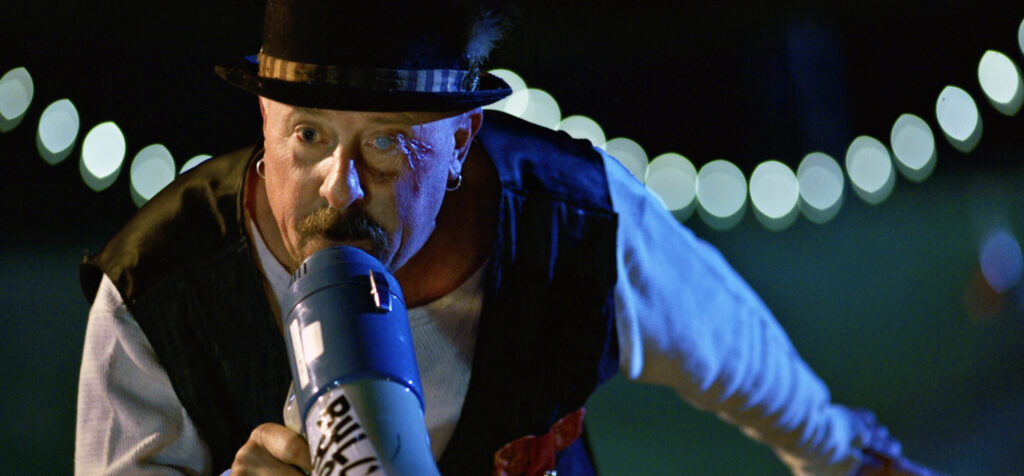
Kurt Deimer as Bull in Hellbilly Hollow.
One of the first things that caught my attention was how much the filmmakers seemed to understand about operating a haunted attraction (mainly ’cause Hellbilly Hollow is a real haunted house located in Vincent, Alabama). We get glimpses of actors preparing their makeup, customers behaving like complete idiots and the frantic atmosphere that comes with keeping an attraction running. There’s even a moment when Bull brings Tickles some pizza, which immediately brought back memories of my own haunt days.
I also appreciated that the film opens with violence in broad daylight. Seeing the attraction without the protection of darkness is an interesting choice, especially because anyone who has worked in the industry knows how dramatically an environment changes once the sun goes down. These little touches gave me hope that Hellbilly Hollow might offer something special.
Tickles is another element that initially works surprisingly well. With his disfigured appearance, limited speech and imposing presence, he reminded me of Leatherface from the original The Texas Chain Saw Massacre. But the similarities extend beyond his appearance. Despite being capable of horrific violence, Tickles often behaves like a frightened child seeking approval from the people around him. His relationship with Bull is particularly interesting, as he seems eager to please the man even while committing some truly gruesome acts.
There are moments when Tickles almost becomes sympathetic, particularly when the film explores his attachment to a mysterious woman he calls Mama. It’s an unsettling contrast that could have made him a memorable horror villain.
The film also deserves some credit for its creative approach to murder. Rather than relying exclusively on traditional slasher techniques, Hellbilly Hollow transforms familiar carnival games into deadly attractions. A Whack-A-Mole-style game becomes something considerably more disturbing when the targets are actual people. Another sequence involves a human dartboard, while a particularly elaborate dunking game turns a carnival favorite into a horrifying execution. The cleverest part is that unsuspecting customers often believe they’re witnessing elaborate special effects rather than actual violence.
Having spent years watching haunt guests struggle to distinguish reality from theatrical scares, I found that premise genuinely entertaining. There’s a twisted sense of humor buried in these scenes, and when the movie embraces it, there are flashes of something worthwhile.
Unfortunately, those flashes are buried beneath one of the most frustrating editing approaches I’ve encountered in quite some time.
Watching Hellbilly Hollow reminded me of trying to read a newspaper the wrong way. Imagine starting at the left side of the page and reading straight across every column instead of finishing one column before moving to the next. Eventually, you’d have all the information, but good luck making sense of anything along the way. That’s exactly how this movie handles its multiple storylines. Just when something interesting starts happening, we’re whisked away to another character doing something completely different. Then, before that scene has an opportunity to develop, we’re jumping somewhere else again.
It’s as though someone took three separate stories, shuffled their pages together and decided that was good enough.
The movie constantly bounces between Bull and Tickles, the paranormal investigators, and a supernatural backstory involving a mysterious voodoo practitioner and a traveling carnival. There’s nothing inherently wrong with telling multiple stories simultaneously. Plenty of great horror films do exactly that. But those transitions need to serve a purpose, whether it’s building suspense, revealing information or connecting events. Here, the constant switching feels chaotic for no reason. Even relatively mundane moments are interrupted by unrelated scenes, making it incredibly difficult to become invested in any particular storyline. By the time the film finally begins connecting its various threads, I was spending more energy trying to remember what happened earlier than actually enjoying what was happening on screen.
The paranormal investigators don’t make matters any better.
Horror movies have a long tradition of characters making terrible decisions, and I’m generally willing to forgive a little stupidity if it keeps the story moving. But there’s a point when questionable judgment becomes downright ridiculous. At one point, the investigators discover a severed human head in the woods. Now, I don’t know about you, but finding someone’s head lying on the ground would be a pretty strong indication that it’s time to get the hell out of there.
Instead, these people seem to approach the situation with all the urgency of someone deciding whether to order dessert. They talk about leaving, stop to review footage and continue having conversations when any reasonably intelligent person would already be halfway to the next county. It’s difficult to fear for characters who don’t seem particularly concerned about their own survival.
The special effects are another major disappointment. For a movie built around elaborate murders, the gore needs to deliver, and far too often it doesn’t. The opening kill features a promising practical-looking disembowelment that is immediately undermined by an obvious digital blood spray. Later, a carnival strongman game results in a head-crushing death that looks painfully artificial. These moments are particularly frustrating because the underlying ideas are often quite good.
The filmmakers clearly have an imagination when it comes to designing kills, but the execution repeatedly falls short. There are exceptions, including an impressive explosion late in the film, but the overall effects work is wildly inconsistent. Sometimes less really is more, especially when the alternative is CGI that immediately pulls the viewer out of the experience.
And then there’s the ending.
Without getting into spoilers, Hellbilly Hollow attempts to tie its supernatural mythology, carnival history and surviving characters together in a finale that left me more confused than satisfied. The movie introduces revelations about its characters and their relationships, but instead of making everything click into place, those revelations seem to create even more questions. By the time the credits begin rolling, I was still trying to figure out exactly what the filmmakers wanted me to understand.
Ambiguous endings can be wonderful when they’re handled correctly. They can leave audiences thinking about a movie long after it’s over. But there’s a difference between deliberate ambiguity and storytelling that simply fails to communicate its ideas. Unfortunately, this feels much closer to the latter.
What’s especially disappointing is that I can see the ingredients for a much better movie hiding somewhere inside Hellbilly Hollow. The haunted attraction setting is promising, Tickles has the potential to be a fascinating villain and the carnival-themed murders offer some genuinely inventive moments. There’s even an interesting supernatural mystery that might have worked if the filmmakers had given it enough room to develop.
But instead of building on those strengths, the movie continually gets in its own way. Every time something starts working, another unnecessary cut, questionable character decision or unconvincing visual effect comes along to ruin the momentum.
Ultimately, Hellbilly Hollow earns one out of five stars.
There are a handful of genuinely good ideas here and my appreciation for haunted attractions made me want to enjoy this movie far more than I actually did. But those scattered positives simply aren’t enough to overcome the chaotic editing, confusing storytelling, weak digital effects and frustrating character behavior. After spending so many years working in haunted houses, I’ve learned that a good maze should leave visitors feeling lost, frightened and desperate to find their way out.
Unfortunately, Hellbilly Hollow manages to accomplish something similar with its screenplay. The difference is that when I finally found the exit, I wasn’t screaming in terror. I was just relieved it was over.
Hellbilly Hollow can be found HERE