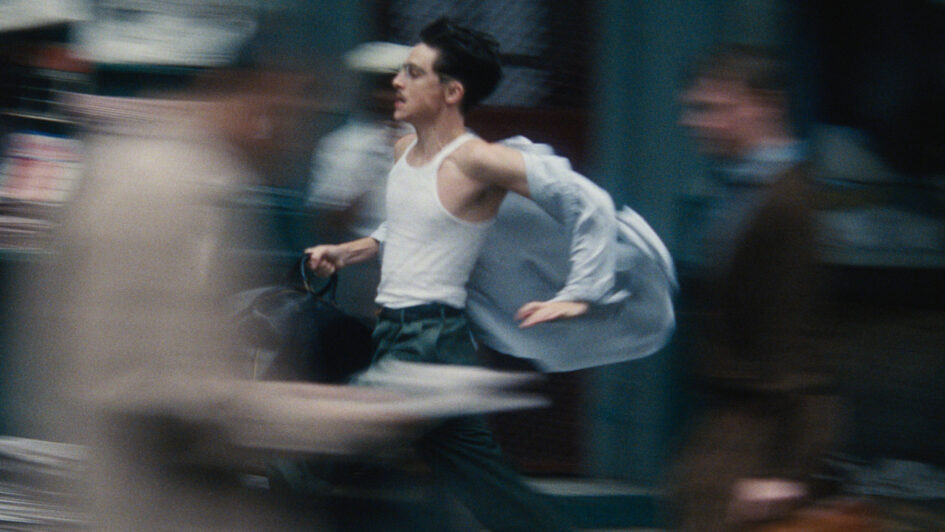
I have lived my entire life under the foolish assumption that only the Big Sports are allowed to be ruthless. Football. Boxing. Hockey. The ones where teeth are lost, careers end on stretchers, and someone’s uncle still insists the game was “tougher back in his day.” Nobody ever sat me down and said, “Hey, just so you know, the truly unhinged levels of competitiveness are hiding in the sports you’ve never bothered to Google.”
Because if they had, I would have been emotionally prepared for the discovery that table tennis once operated like a Cold War thriller with paddles.
Watching Marty Supreme felt like accidentally walking into an underground fight club, except instead of fists it’s spin serves, side-eye and career-ending shade thrown over a folding table. I went in expecting polite claps and wholesome sportsmanship and instead found myself staring at a world where reputations are destroyed over a missed return and grudges are apparently passed down like family heirlooms. It turns out when a sport doesn’t get primetime coverage, it compensates by being absolutely feral behind the scenes.
Written, directed and produced by Josh Safdie, Marty Supreme charts just how far one man is willing to go for the ultimate American dream: ending up on the front of a Wheaties box. Marty Mauser (Timothée Chalamet) spends his days working at his uncle Murray’s (Larry Sloman) shoe store, but only because it pays the bills. The job is a pit stop, not a destination. Marty has his eyes locked on a much stranger prize: He wants to be the greatest table tennis player in the world, and he treats that goal with the kind of obsession usually reserved for war generals and cult leaders.
Nothing is off-limits in Marty’s pursuit of greatness. He entangles himself with Rachel (Odessa A’zion), a young married woman, and leaves chaos in his wake when she becomes pregnant. With the same slippery charm, he pulls former actress Kay Stone (Gwyneth Paltrow) into his orbit, convincing her to bankroll and believe in his impossible vision. Her husband, Milton Rockwell (Kevin O’Leary), is far less impressed and sees Marty for the walking disaster he is.
Marty, of course, does not care. Heaven, hell or somewhere in between, he is willing to bulldoze anyone standing between him and his dream.
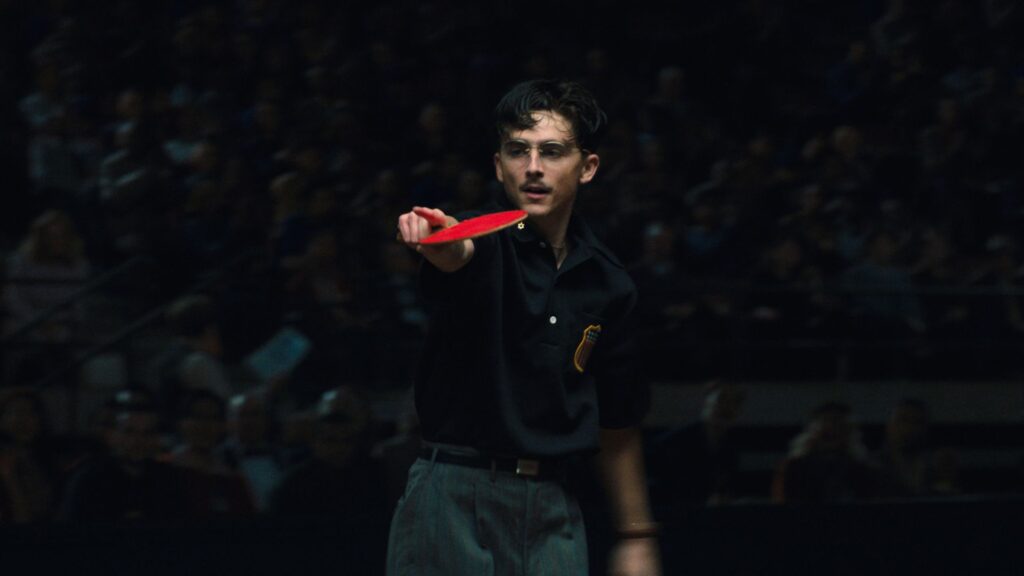
Watching Timothée Chalamet here immediately calls back to his turn as Bob Dylan last year in A Complete Unknown, not because the characters are alike, but because the commitment is identical. Just as he disappeared into Dylan’s voice, posture and musical rhythms, Chalamet goes all in again, this time trading guitars for paddles. He reportedly learned to play table tennis at a legitimately impressive level, and it shows in the way the matches are filmed.
Nothing feels faked or stitched together in the edit. On top of that, he adopts a clipped, era-specific delivery pulled straight from a 1950s drama, giving his dialogue a sharp, old-school cadence. It is another reminder that when Chalamet takes on a role, he does not dabble. He commits until the previous version of himself no longer exists.
As strong as Chalamet is, Marty Supreme truly shines in the performances of the women orbiting him, who provide the film with much of its emotional weight. Odessa A’zion is the standout of the cast, grounding the chaos as Rachel, a woman who stands by Marty with a loyalty that borders on tragic. There is a quiet resolve in her performance that makes every compromise and sacrifice feel painfully earned. Gwyneth Paltrow, meanwhile, brings a heavy, lived-in sadness to Kay, a woman who has settled into comfort and status at the cost of her own spark. Paltrow plays her not as naïve, but as knowingly compromised, someone willing to demean herself just to feel alive again through the reckless energy Marty injects into her world.
Together, these performances add depth and consequence to Marty’s ambition, reminding us of the human cost behind his relentless drive.
Marty Supreme is undeniably fun, but it is also a lot. The movie barrels forward at a relentless pace, stacking twists, reversals and chaotic outbursts until it almost dares you to tap out. Just when the story threatens to settle into a rhythm, it swerves again, tossing in another confrontation, another scheme, another emotional grenade. That constant escalation is thrilling in short bursts, but across the full runtime it becomes exhausting, like being strapped into a roller coaster that never pulls back into the station.
By the end, I was entertained, impressed and weirdly tired, needing a breather after a film that refuses to slow down.
That chaos comes at a cost. With so many storylines, schemes and emotional threads flying at once, Marty Supreme occasionally forgets to stick the landing. Several plotlines feel carefully set up for major payoffs, only to fizzle out or simply stop once the movie charges toward its next big moment. Characters drift in and out, conflicts dissolve without resolution and ideas that seem important are quietly abandoned. The result is a slightly unfinished feeling, as if the film is too busy sprinting forward to check whether everything it introduced actually mattered.
I give Marty Supreme three out of five stars. Even with its flaws, there is no denying that Timothée Chalamet, Gwyneth Paltrow and Odessa A’zion are all poised to either win or place high during the upcoming awards season. Each delivers a performance that is fully committed, emotionally layered and impossible to ignore, even when the film, itself, starts to wobble.
Safdie’s movie runs on pure, caffeine-fueled energy, crackling with chaotic momentum, but like any energy drink, that rush does not always last. The buzz wears off; storylines get dropped and the missing payoffs make it harder to fully savor the experience.
Marty Supreme circles right back to my initial surprise: the realization that the most vicious competition often hides in the least expected places. The film captures that feral intensity beautifully, even if it occasionally trips over itself trying to keep up.
I walked away entertained and slightly exhausted, newly aware that beneath the polite surfaces of “lesser followed” sports lies a world just as ruthless as any major league, only with fewer cameras and far sharper elbows.