I went into 28 Years Later expecting water. Clean, familiar, maybe a little stale from sitting out too long, but ultimately recognizable. I expected the cinematic equivalent of rehydration, something that would remind me why this series mattered, hit the old notes, and let me settle back into a world I already understood.
Instead, I picked up the cup, took a confident gulp and immediately realized this was vodka.
No warning. No chaser. Just a sharp, burning reminder that assumptions are dangerous things, especially when you’re dealing with a franchise that has never been particularly interested in making its audience comfortable.
At first, that realization kind of sucks. Your body rejects it. Your brain scrambles to recalibrate. This is not what you ordered. But then something strange happens. You adjust. You feel the heat settle in. You start to understand that while this experience is harsher, messier and far less forgiving than what you expected, it’s also more honest. You might not enjoy every second of it, but you also can’t deny its effectiveness. By the time you’ve finished the drink, you’re not sure you hated it. You’re just acutely aware that it changed you a little, whether you wanted it to or not.
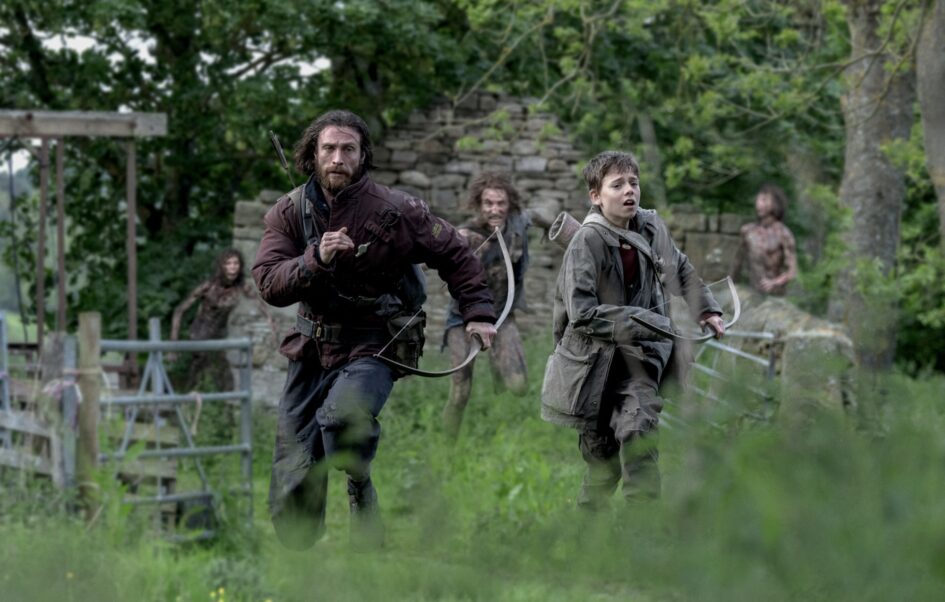
28 Years Later is the third entry in the Rage Virus saga, with Danny Boyle returning to the world he introduced in 28 Days Later. Set 28 years after the original outbreak, the British Isles remain under quarantine, with the infected having survived long enough to evolve into more organized and dangerous forms, including dominant, hyper-aggressive “Alphas.”
The story follows a boy named Spike (played by Alfie Williams), and his father, Jamie (Aaron Taylor-Johnson), who enter the quarantined zone on what is framed as a coming-of-age hunting trip, only for Spike to uncover rumors of a surviving doctor named Ian Kelson. As Spike’s mother, Isla (Jodie Comer), is gravely ill, he risks everything by taking her back across the causeway in hopes that Kelson (Ralph Fiennes), if he truly exists, may be her last chance at survival.
Going into 28 Years Later, I was genuinely excited. The first two films earned that excitement. 28 Days Later redefined what an infected movie could feel like and 28 Weeks Later doubled down on chaos and brutality. The marketing leaned hard into that legacy. The trailers promised something gritty, bleak and relentlessly dark; a return to a world where hope is a liability and survival is soaked in blood.
That is not the movie I got.
28 Years Later is far less interested in being an ultra-dark horror film than it is in being a family drama that happens to take place in a world with infected people. The emotional core revolves around parents and children, grief, responsibility and the fear of losing loved ones, rather than the fear of being torn apart by the infected. The “Zombies” are present and dangerous, but they often feel secondary to the interpersonal conflicts driving the story.
That disconnect between expectation and reality left me feeling misled, not because the film is poorly made, but because it is telling a fundamentally different story than the one it sold.
One of the places where the film really lost me was in its editing. There are some baffling choices that constantly interrupt the rhythm. Awkward pauses feel deliberate, but never meaningful. Scenes linger too long and then cut away abruptly. Random inserts appear without clear narrative purpose. The musical choices only make this more distracting, with needle drops that arrive without setup and stick out like sore thumbs instead of enhancing the mood.
More than once, I found myself pulled out of the film entirely, not by what was happening, but by how it was being presented. The overall effect reminded me of House of 1000 Corpses, specifically that choppy, abrasive editing style often associated with Rob Zombie. That kind of chaos can work when excess is the point, but here it clashes with a film that wants to be grounded and emotionally driven.
I also struggled to care about the characters, which made the film’s emotional beats fall flat. There are moments clearly designed to hit hard, pauses meant to invite reflection or heartbreak, but I was never invested enough in the people on screen for any of it to matter. The issue isn’t the performances, but the lack of development needed to make those struggles feel earned. Without that connection, the story drifts, moving from scene to scene without urgency or consequence. Considering the talent involved, it feels like an absolute waste, resulting in a film that comes across as uneventful and dull rather than emotionally affecting.
And I am not even going to address the ending. I didn’t need the British version of the Mighty Morphin Power Rangers showing up, but here we are.
Probably the best part of 28 Years Later is its use of location. Visually, the film is often stunning, finding beauty in decay and stillness even when the story itself struggles to engage. The landscapes feel vast, abandoned and quietly hostile, reinforcing the sense that the world has moved on without waiting for humanity to catch up. It’s the kind of environmental storytelling this series has always done well.
The standout is the Bone Temple, which is genuinely striking. It’s haunting and oddly reverent, a visual that communicates history, obsession and loss without needing much explanation. Moments like this hint at a richer, darker film living just beneath the surface. Even when I was emotionally disconnected from the characters, I couldn’t deny how effective and memorable the settings were.
I give 28 Years Later two out of five stars. In the end, the film left me feeling much the same way I did with that first unexpected sip. I reached for water and got vodka instead. It wasn’t what I wanted, it burned more than I expected and it lingered in ways that weren’t always pleasant. There are things to admire here, especially the locations and visual ambition, but they aren’t enough to outweigh a film that feels emotionally distant, unevenly edited and far less gripping than it was sold to be.
I didn’t hate the experience, but I didn’t enjoy it, either.
Jason Kittrell
Jason Kittrell is a member of the Music City Film Critics Association and he's also active within the horror community.