I have been cleaning out my old house lately, the kind of slow-and-dusty process that sends you drifting down memory lanes you did not even know were still open. In one of the back closets, I found a stack of old photo albums, the heavy kind with thick pages and cellophane that peels back like a secret waiting to be told. Inside were pictures of my grandparents, smiling in grainy black and white, holding hands at picnics, standing in front of an old truck I never knew they owned. They were married for ages, long before I came along, long before my own timeline even existed.
Staring at those photos made me wonder about the parts of their lives I never got to know. Were they each other’s perfect choice, or was there another long-lost love tucked away somewhere in their hearts? I had not expected a movie to stir those questions any deeper, but Eternity did exactly that.
The film has one of the most quietly romantic premises I have seen in years. When people die, they arrive at a waystation known as the Junction. It is a busy place, but it’s also one that feels warm and free of judgment. Souls are given one week to make a single choice. They must decide where and with whom they want to spend eternity.
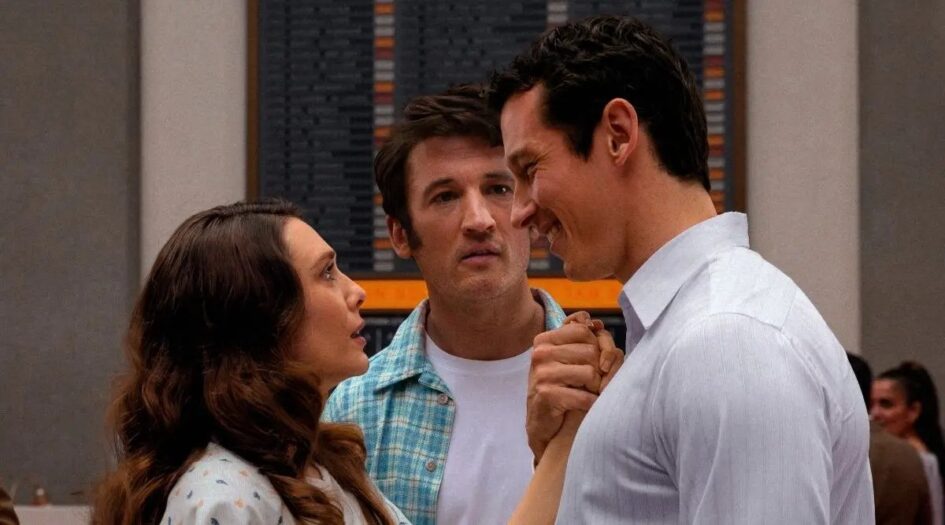
Joan Cutler (Elizabeth Olsen) arrives and is quickly reunited with her recently deceased husband, Larry (Miles Teller). Their lives together were long and full, built on years of shared routines and ordinary moments that became meaningful simply because they shared them. But the Junction holds a surprise. Another man has been waiting for Joan. Luke (Callum Turner) was her first love and husband before war took him from her too soon.
Suddenly, Joan must consider two versions of her life. The one she lived and the one she lost. And her choice will determine their eternities.
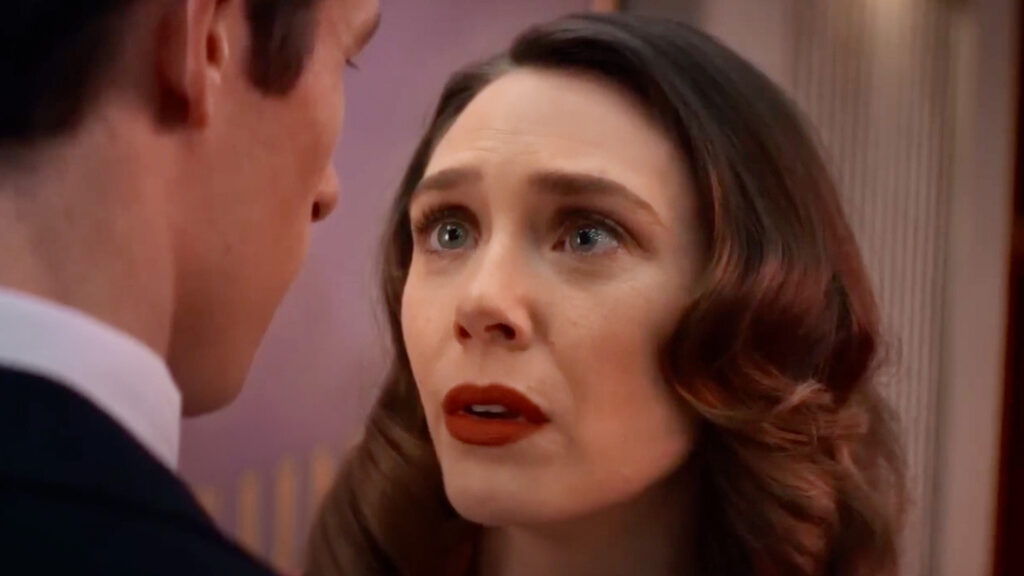
That simple setup opens the door for a story that is both soft and emotionally resonant, with moments of comedy. The film avoids spectacle and instead leans into reflection. Joan is not choosing between good and bad. She is choosing between the comforting familiarity of a life that grew naturally over time, with all its ups and downs, and the ache of a love that ended before it ever had the chance to truly begin.
Watching her face these emotional crossroads brought me right back to those photo albums. I kept imagining my grandparents in a place like the Junction. Would they walk toward each other immediately, ready to spend eternity with the person who walked beside them through time? Or would they take a moment to look around? Would someone from their younger years be waiting there, someone whose story was left unfinished?
Olsen brings a gentle authenticity to Joan. She plays the character with an emotional openness that feels deeply human. Her expression when she first sees Luke again is layered with surprise, longing and an almost painful sense of recognition. Turner captures the romantic glow of first love, the kind that feels suspended in memory. Teller brings a cockiness to Larry, whose love for Joan may not burn with the intensity of youthful passion, but carries the glow of lived experience. The triangle never becomes cruel or petty.
The film respects each man and allows Joan’s indecision to unfold slowly.
The Junction, itself, is a delightfully restrained creation. Instead of a grand cosmic arena, it has the feel of a bustling convention center. Souls wander through crowded hallways, often being berated by eager salespeople trying to convince them to commit to the eternity they are selling. The environment perfectly matches the tone of the film. It is comically entertaining, right down to ads for places like a smoker’s paradise, because cancer cannot kill you twice, and for 1930s Germany, now with 100 percent fewer Nazis. These jokes land well and serve as welcome reminders that the afterlife — at least here — has room for humor.
What sets Eternity apart is how honestly it explores the idea that love is not always singularly focused. A lifetime of love does not erase the memory of a first love. A lost possibility does not diminish a lived marriage. Both can coexist in the same heart without contradiction. Larry represents the story Joan actually wrote with another person. Luke represents the unwritten chapters that were torn away before they could be lived. Both matter, even if only one can go forward.
As Joan’s decision unfolds, I kept thinking about those photos again. The way my grandfather held my grandmother’s hand in every one of them. The way she leaned into him with a soft familiarity. But I also wondered what stories had taken place long before those pictures were snapped. The crushes from adolescence. The dances with people whose names never made it into family lore. The letters exchanged during long separations. The heartbreaks they never talked about.
Life is filled with these hidden narratives, and Eternity beautifully taps into that truth.
I give Eternity four out of five stars. The film does not rush to answer its own questions, and it certainly does not answer mine. Instead, it offers a fun space for reflection. By the time Joan chooses her path, the emotional payoff feels sincere and earned. It is not a twist or a shock. It is an honest conclusion to a personal journey.
Eternity is not a film built on big, dramatic gestures. It is a film built on small, tender revelations with laughs sprinkled in. It moved me in a way I did not expect, and by the end I found myself thinking not just about Joan, but about the people in my own past and the long lives they lived before I ever entered the picture. It is a quietly affecting story that lingers gently, much like the old photographs I rediscovered in that closet.