My first trip to IKEA felt like stepping into a maze designed by someone with some serious anti-social issues. I figured I’d be in and out in no time. I had a plan. I knew exactly what I needed, and I was convinced I’d be back in the parking lot within 30 or 40 minutes. Instead, I spent what felt like an eternity wandering through endless showrooms and perfectly staged living rooms, convinced the exit had to be just around the next corner.
Every shortcut I thought I’d found somehow led me right back to where I started. By the time I finally made it out and realized there had been maps hanging overhead the whole time, I wasn’t sure if I’d escaped the store or if IKEA had simply decided to let me leave its clutches.
Getting lost inside a building is a strange kind of frustration. Outside, you can usually find a landmark or pull out your phone to get your bearings. Indoors, especially somewhere built around long hallways and identical rooms, every turn starts to look the same. Confidence slowly gives way to doubt. You begin questioning your own memory.
The more certain you are that you’re going the right way, the easier it becomes to convince yourself you’re completely lost. In a lot of ways, getting lost in an IKEA, a casino, a hospital or any other sprawling building feels like an allegory for life, itself. We all like to think we know exactly where we’re headed until one wrong turn leaves us wondering how we got so far off course.
That feeling of uncertainty sits at the heart of Exit 8.
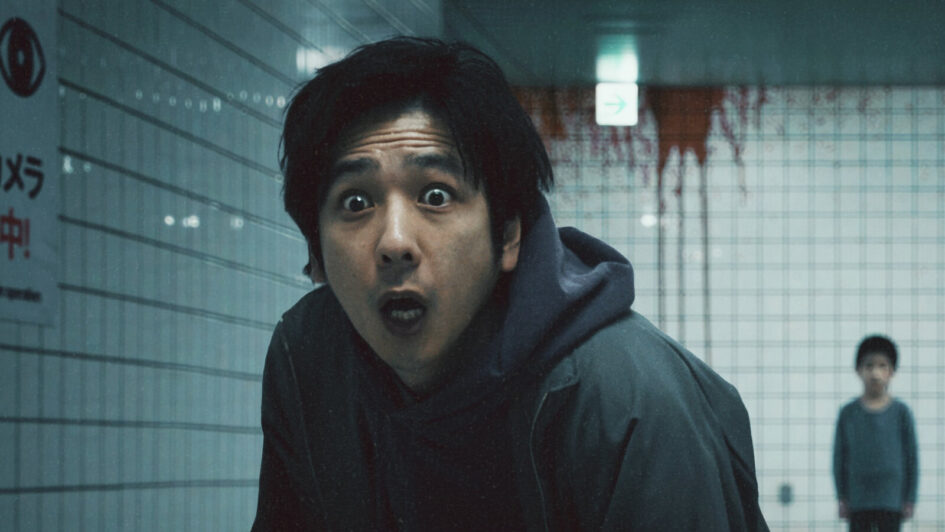
Based on the indie video game of the same name, the film follows a man (Kazunari Ninomiya) who finds himself trapped in an endless underground subway with only a cryptic set of instructions to guide him. If everything appears normal, he must continue toward the exit. If he notices even the slightest anomaly, he must immediately turn back.
One wrong decision sends him right back to the beginning, forcing him to rely on his powers of observation, if he ever hopes to escape the loop.
Exit 8 Walking Man
I never had the chance to play Exit 8, but I spoke with several friends who did. The comparison that kept coming up was the unsettling atmosphere found in the Backrooms games. Not because the stories are similar, but because they evoke the same uneasy feeling of being trapped in a place that should feel familiar but somehow doesn’t.
From everything they described, the film captures that atmosphere remarkably well. Rather than simply recreating the game’s mechanics, writer-director Genki Kawamura translates the tension of constantly questioning your surroundings into something that works just as effectively on the big screen. By the end of the film, I understood exactly why the game left so many players feeling unsettled.
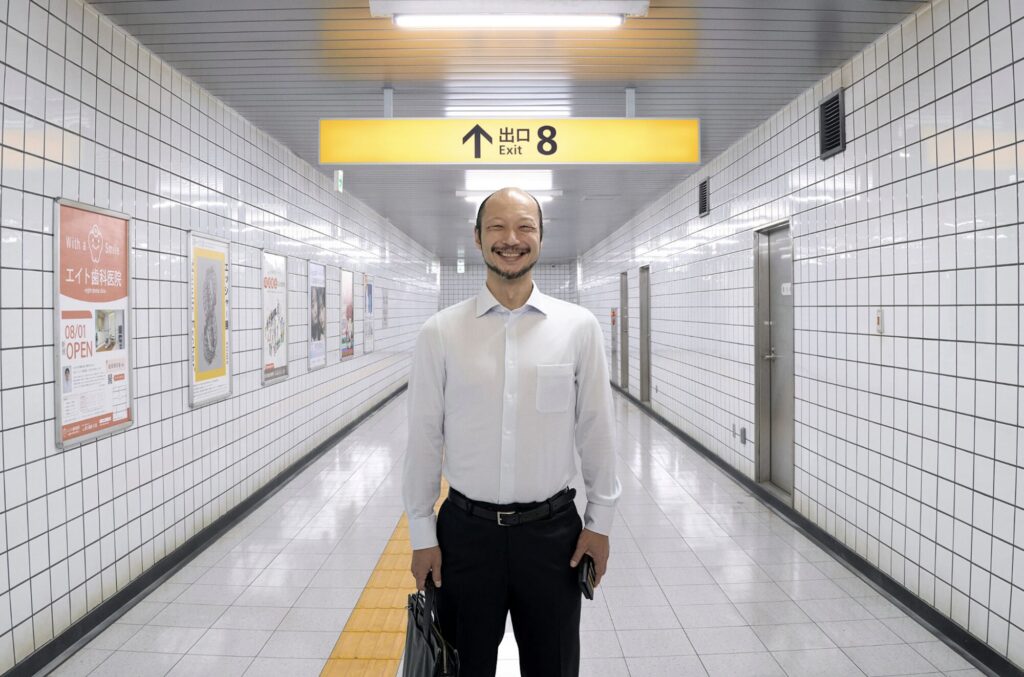
The first thing that impressed me was the set design. On paper, there’s nothing particularly elaborate about it. It’s mostly a series of clean subway tunnels with plain walls, tiled floors, fluorescent lights and the occasional sign or advertisement. Yet that simplicity is exactly what makes it so effective. The corridors somehow feel endless while also becoming increasingly claustrophobic, creating the unsettling sense that there is no real escape.
Every stretch of hallway looks familiar enough to make you second guess yourself, but just different enough to keep you searching for what has changed. It’s proof that you don’t need an extravagant set to create tension. Sometimes the simplest environments are the ones that get under your skin the most.
Exit 8 also makes remarkable use of its limited cast. Kazunari Ninomiya carries nearly every scene, conveying mounting frustration and anxiety with surprisingly little dialogue. The handful of characters he encounters, portrayed by Yamato Kochi, Naru Asanuma, Kotone Hanase and Nana Komatsu, each adds another layer of uneasiness to the journey. You’re never quite sure what their role is in this whole affair.
Are they real people, or simply another piece of the puzzle? Of the supporting cast, Naru Asanuma leaves the biggest impression, with an emotional arc that rivals Kazunari’s own by the film’s conclusion.
None of this would have worked without Genki Kawamura’s direction. On the surface, he’s asking us to watch someone walk down the same sterile-looking hallways over and over again. That shouldn’t be compelling, yet it never feels repetitive. Kawamura understands exactly when to linger on a shot, when to build anxiety and when to let the audience’s imagination do the heavy lifting. Rather than relying on loud jump scares or elaborate visual effects, he creates tension by making us question everything we see.
Before long, you’re studying every sign on the wall, every minute detail and every interaction alongside the Lost Man, wondering if you’ve spotted something that shouldn’t be there. Somewhere along the way, I realized I had stopped watching the movie and started playing the game myself.
I give Exit 8 five out of five stars. Much like my first trip through IKEA, what should have been a simple walk from one point to another became something I wasn’t likely to forget. Genki Kawamura proves that horror doesn’t need elaborate monsters or buckets of blood to get under your skin. Sometimes all it takes is an ordinary hallway, a feeling that something isn’t quite right and the creeping realization that you can no longer trust your own eyes.
Exit 8 is a masterclass in atmosphere, restraint and psychological tension, reminding us that the scariest places are often the ones that look perfectly ordinary. Just don’t be surprised if the next time you’re wandering through a long corridor, you slow down and start paying a little more attention to what’s around you.