
Back in the day, when I was a freshman in college, I had already realized how much of a fan of nostalgia I had become. That self-awareness of this Child of the ’80s dragged me to Chuck E. Cheese with my best friend, as we played Skee-Ball and laughed at our ridiculousness while Munch’s Make Believe Band cranked out the retro vibes for a fun weekend afternoon. It didn’t matter that we were often the oldest people in the restaurant, enjoying the presence of animatronic animals that were a symbol of our childhood’s happy times. We recognized that, because we were children at heart.
Some of that childhood clarity bleeds into Stolen Kingdom, but it then takes a terrible turn…
In this documentary film, the Disney black market is examined as a true-crime angle focuses on a topic I had no previous knowledge about, urban exploration. While I admit to having seen a little about the topic when dealing with paranormal researchers, I’d never been interested in watching any “adventures in theme-park exploration” on YouTube before, which means people are actually sneaking into private property to film behind-the-scenes locations that are off limits to the general public and later posting their shenanigans online to gain five minutes of fame.
I guess there’s an adrenaline rush to those who participate. I simply see it as incriminating evidence, once the offenders are eventually caught. Which they usually are.
Stolen Kingdom follows a group of these urban explorers, who sneak into abandoned locations of “the happiest place on Earth,” aka Walt Disney World, which is a slippery slope for the rule breakers. And the film defines three types of these urban explorers:
- The pre-World Wide Web people who love attractions on an artistic, emotional level.
- The people who enjoyed the park’s history but prefer money and notoriety even more.
- The people without any connection to the theme park at all who just want to push the limits of new extremes.
Now that we’ve got the roles defined for our stars of the movie, the audience is treated to some naughtiness caught on camera. What begins as teenagers and young adults exposing lax security in long-forgotten locations of the park, some are brought backstage by cast members to explore… other offenders are cast members, or were Disney employees, to be precise.
And when seemingly irreplaceable items go missing, fingers start pointing toward the “Disney cult fan community.”
“Disney black market has kind of always been a thing…”
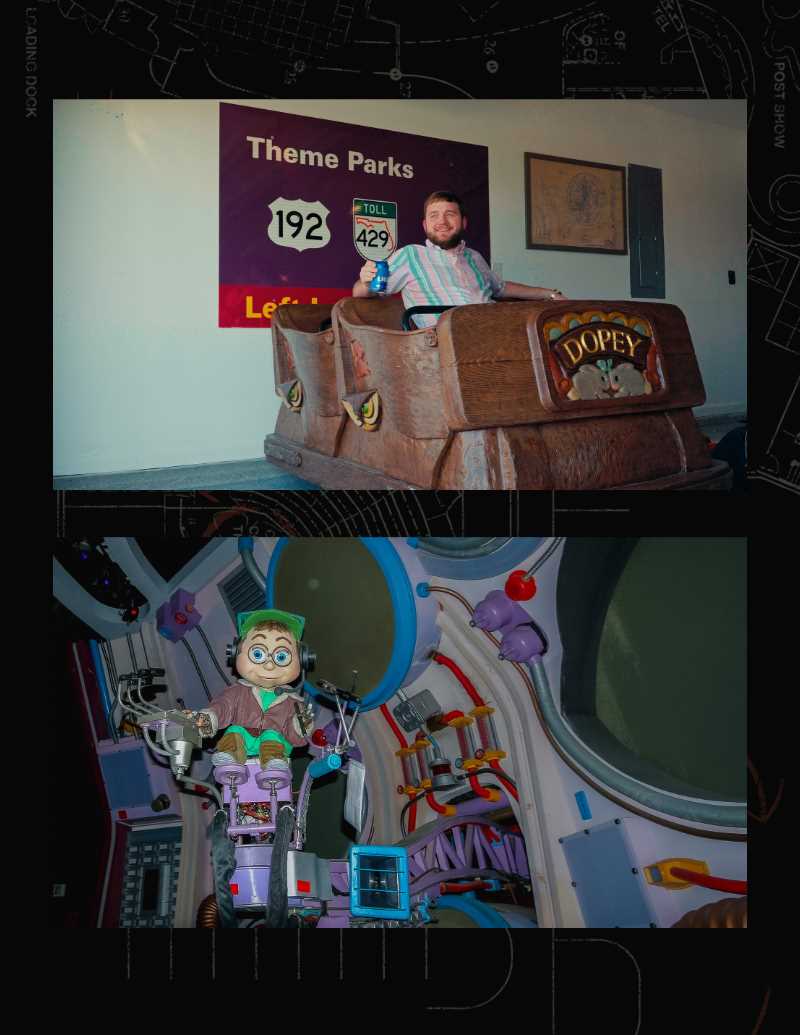
Behind the scenes of Walt Disney World with Buzzy.
Eventually, it all boils down to this: What happened to Buzzy, the animatronic star of Epcot’s Wonders of Life attraction (which is now closed)?
Through a variety of direct statements (and way too many implications), we learn that more than one person had an interest in this child-like robot (that was actually the size of a large kid) of Future World. Local news reports and archive footage directly from the park detail the heist and the dragnet tightens as police interrogation footage of Patrick Spikes makes it feel like accountability is coming… but it never actually happens. Because of this, the film ends anticlimactically.
And that’s when the urban legend kicks in. Buzzy’s still missing in action.
Documenting is one thing, but theft is something different, all together. Neither one is worth risking your life, but content creation must be created. As a newcomer to this community, I’m not ashamed to say that if you do the crime, you should definitely do the time. Burglary, grand theft and trafficking stolen property are threatened, but Spikes (and his cousin, the accomplice) strike plea deals for probation, restitution and lifetime bans from all Disney properties. But that doesn’t feel like enough.
Some of these people had rough childhoods and worshipped Disney World as a beacon of hope in their lives. Others just wanted the money. And now, since Disney World left multiple attractions in a sort of suspended animation until these explorers broke in and discovered them, the park should share some of the blame. But customers would definitely pay good money to tour museums of closed Disney attractions. That actually piques my interest, and I’m not a big Disney theme park fan.
After watching Stolen Kingdom, I’m saddened that I never witnessed Buzzy’s audio-animatronic show from yesteryear, thanks to first-time filmmaker Joshua Bailey. But I’m also turned off about all of the shady stuff that’s going on, which feels like a How to Steal guide at times, and that makes me feel icky. Since this is the feature-film debut of the multi-hyphenate filmmaker (appearing here as the co-writer, director and producer), he should receive some of that blame, as well. A little more focus in his storytelling could have straightened the movie’s theme out a little better.
Exposing the Dark Side of Disney is one thing, but promotion shouldn’t be a part of it.
And that’s where Adam the Woo somehow fits in. He played a big role within this community, and it seems that he asked multiple times not to be a part of this film. Then he passed away. And yet he still made an appearance, posthumously. Fans are up in arms about the inclusion, although I found it brief enough to be non-essential to the storyline, which means he could have easily been left out, and it wouldn’t have made a big difference to the overall movie.
As I’ve grown older, animatronic robots still hold a special place within my heart, even though I haven’t returned to Chuck E. Cheese since discovering all the previous token-only arcade cabinets have become card-swiping machines that now spew nothing but tickets to games of chance. Stolen Kingdom simply reminds me of a previous life, one which fades just a little bit as each day goes on.
So, is this a Buzzy remembrance film, or simply an ego trip for all the people who previously broke into the House of the Mouse? Yes. Rest in peace, Buzzy.
“Even though Disney’s a place of fantasy, it is not immune to crime.”