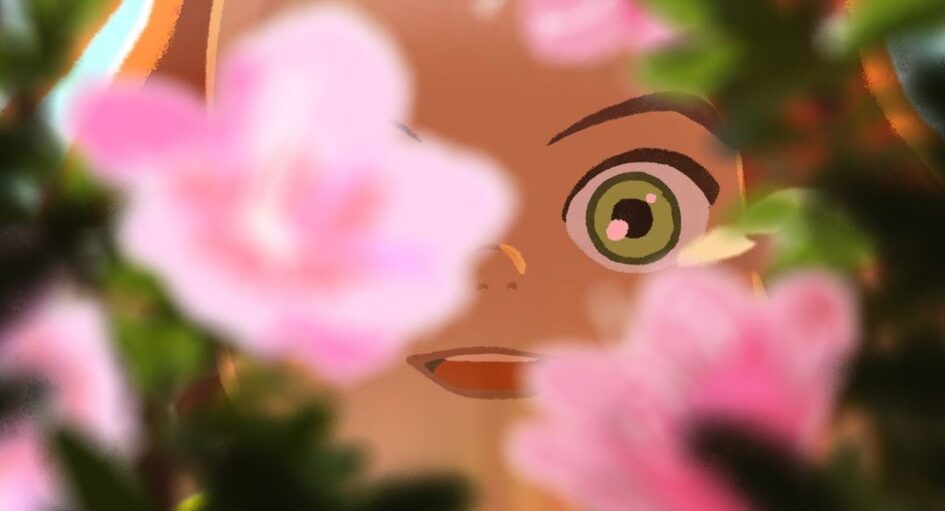
When it comes to ground-breaking, existential children’s stories, I can’t think of too many off the top of my head. I mean, The Cat in the Hat explaining the Big Bang Theory to kids (and adults) might actually be a winning formula for selling books in 2025, so I could be onto something big. Filmmakers Maïlys Vallade and Liane-Cho Han have definitely found the winning formula for creating something special visually and emotionally stimulating with Little Amélie or the Character of Rain, a big-screen adaptation of Amélie Nothomb’s autobiographical novel, bringing a complex story of healing and human connection to life.
And much like Flow, which won the 2025 Best Animated Feature Oscar in a historic upset as a foreign film, Little Amélie is already padding its stats, winning the feature Audience Award at the Annecy International Animated Film Festival, the Grand Prize at the Bucheon International Animation Festival, the Audience Award for Best European Feature at the San Sebastian International Film Festival, the Grand Jury Prize at the Animation Is Film Festival and Golden Camera nominee at the Cannes Film Festival.
And now, American audiences finally get the opportunity to experience the sweet, transformative and sometimes rambunctious adventures of a 2-year-old trying to get her feet on the ground in an attempt to understand it all.
Written by Liane-Cho Han, Aude Py, Maïlys Vallade and Ediine Noël and directed by Vallade and Han, this animated adventure (clocking in at 78-minutes long) creates a multi-cultural collaboration, as a young Belgian family adapts to traditional Japanese values via the French language. It’s not quite edu-tainment, but after watching the film, I felt like I learned a thing or two about living in the Land of the Rising Sun.
“Like the rain, I was exquisite and perilous, benign and deadly, silent and tempestuous.”

In the Japanese culture, the age of 3 is considered an important milestone for children, one which growth and development is measured. It’s also a time when young ones are considered closer to God than a fully grown human. It is with this wide-eyed wonder that Amélie takes her first steps and speaks her first words after escaping a vegetative-like state for two years, much to the thankfulness of her family, who consider it all a miracle.
As she learns about life, death and white chocolate candy, it’s obvious this child is wise beyond her years. Much more than simply a coming-of-age movie, Little Amélie touches upon the young character’s attachment to the family’s housekeeper, as well as the emotional truths she experiences through loss and sadness. That dynamic comparison of complexities for such a young person to experience without having much to compare and contrast was not lost onto me.
It’s also one of the main reasons I cried a little by the film’s conclusion.
Presented in beautiful colors through a distinctive animated style, it’s not difficult to connect to Amélie (whose name literally translates to “Rain” in the Japanese language), whether it’s her innocence or the acts of a little monster — we’ve all been there before. And much like the moral of life’s story, this one feels familiar, while being wholly unique in its presentation.
Because of that, I’ll be rooting for this little film as the awards season continues. It might be asking too much to expect a major underdog to win the Best Animated Feature Academy Award by year’s end (for the second year in a row), but I do expect it to rack up more award wins as it gains a larger viewing audience, which should improve its odds to eventually land a Best International Feature Film Oscar nomination, at the very least. Multi-hyphenate filmmakers Liane-Cho Han and Maïlys Vallade made the perfect decision for adapting Belgian author Amélie Nothomb’s novel in their very first big-screen production.
The answer to this existential crisis is easy: Do yourself a favor by catching this one wherever it’s available. For that, The Cat in the Hat would agree.
“When you’re 3, you see everything and understand nothing…”