I’ve loved classic movie monsters for as long as I can remember. Dracula, the Wolf Man, the Creature from the Black Lagoon… they were my bedtime stories, but Frankenstein’s Monster was probably my favorite. So, when Universal’s new Epic Universe park opened with its Dark Universe section, I couldn’t wait to experience Monsters Unchained: The Frankenstein Experiment.
But fate had other plans. After all that anticipation, I discovered I was too big for the ride. My daughter and girlfriend went on without me while I sat in the family-waiting area, listening to their screams echo through the lab I couldn’t enter. In that moment, I couldn’t help but laugh. Maybe I was meant to be on the outside, watching a creation come to life, just like Victor, himself.
I didn’t get the ride that day, but I got something better: A reminder of why Frankenstein still matters.
That same feeling hit me again while watching Guillermo del Toro’s Frankenstein on Netflix. Sitting on my couch instead of a ride seat, I found myself once again on the outside looking in, watching a creator bring life to something both beautiful and broken. Del Toro’s vision isn’t just about a monster stitched from corpses; it’s about the souls we piece together when we try to play God, the parts of ourselves we lose in the process and the humanity that seeps through the seams.
The story follows the familiar legend, but through Guillermo del Toro’s lens it feels freshly tragic. Victor Frankenstein (Oscar Isaac) is a gifted yet prideful surgeon whose obsession with conquering death attracts the attention of a wealthy arms dealer, Henrich Harlander (Christoph Waltz). With Harlander’s money and the support of his brother, William (Felix Kammerer), Victor builds a laboratory, only to complicate matters by falling for William’s fiancée, Elizabeth (Mia Goth), Harlander’s own daughter.
When Harlander pressures him to prove his theories, Victor finally gives life to his creation: The Creature (Jacob Elordi). What begins as triumph quickly curdles into horror as the reanimated being proves both immortal and emotionally aware. Terrified of what he’s unleashed, Victor abandons it. But The Creature eventually returns, not to kill, but to plead for companionship, forcing its creator to confront the true price of playing God: a price that grows darker with every heartbeat.

Visually, Frankenstein is a feast for monster kids like me. Every frame looks like it was stitched together from candlelight and cobwebs. Del Toro doesn’t just film Gothic horror. He builds it, brick by brick, like a mad scientist with a camera instead of a scalpel. The sets drip with atmosphere: storm-soaked rooftops, candlelit halls and laboratories that crackle with lightning. It feels alive, handcrafted and haunted in the best possible way. You can almost smell the dust and ozone in the air.
If you’re a sucker for that old Universal monster mood like me, this one delivers it with style and soul.
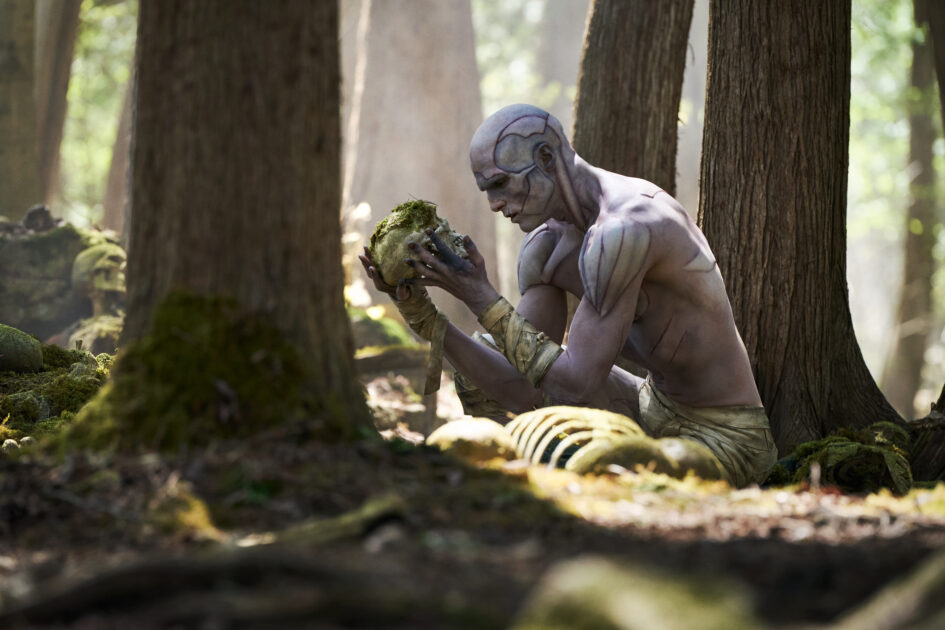
Jacob Elordi’s take on The Creature is something special, not the lumbering brute we’ve seen 100 times before, but a soul caught somewhere between pain and wonder. He moves with this strange mix of strength and fragility, like someone still getting used to the idea of existing. There is a sadness behind his eyes that feels human, which makes his moments of rage hit even harder. You can tell Del Toro did not want a monster this time; he wanted a mirror.
Elordi gives The Creature a voice without needing to say much, and when he does speak, it is with the ache of someone who knows what it means to be unwanted. He is not scary because he kills, he is scary because he feels with unabashed fervor.
Oscar Isaac plays Victor Frankenstein as a man consumed by brilliance and blinded by ego. He is a visionary who truly believes he can outthink death. That belief burns through every decision he makes. There is an intensity in the way he works, a sense that creation has become his addiction, rather than his purpose. But Isaac also lets the cracks show. Behind every proud speech and confident smirk is a man terrified of the consequences of his own genius. His Victor is not just a scientist, but a warning, someone who mistakes ambition for destiny and ends up trapped by his own creation. It is a performance that feels raw, conflicted and entirely human.
You feel for his plight, but deep down you know he dug his own grave.
Del Toro’s Frankenstein stays surprisingly close to Mary Shelley’s original story in spirit, even keeping elements like the Arctic chase that many versions leave out. You can feel his respect for the source material in the pacing and tone, which are slow, poetic and filled with guilt. The film is not trying to shock the audience every few minutes; it is trying to make them feel the burden of creation and the isolation that follows. This is not a monster rampage, it is a meditation on obsession and consequence.
If you come in expecting pure chaos (there is some), you might be surprised to find something quieter but much more haunting. It is not about the monster’s rage, it is about the creator’s regret.
I do feel that the film’s pacing is a little uneven. Del Toro leans hard into the novel’s three-act structure, and that means the story takes its sweet time getting where it’s going. The first act lingers on Victor’s obsession, and by the time The Creature awakens, the ending suddenly sprints to the finish. For those used to lean monster movies, this one moves like a glacier: slow, heavy, deliberate. But that’s the point: it’s not built for jump scares, it’s built to make you sit in the dark and feel.
I give Frankenstein five out of five stars. If you go in expecting a traditional horror monster rampage, you may feel the pacing is slow and the focus is more on emotional, thematic grounds than constant monster mayhem. If you go in expecting a richly crafted Gothic drama about creation and identity, with a creature who carries both pain and poetry, then you will likely find a lot to love.
Watching the film felt a little like sitting in that family-waiting area at Epic Universe again. I could not ride the attraction, but I still got to witness the magic from just outside the lab. Del Toro’s version invites us all to do the same, to look at the creation from a distance, to feel its heart beating through the screen, and to remember why we fell in love with monsters in the first place. This is not a film that screams, it hums with sadness and awe. It reminds us that being human, like being monstrous, means being stitched together from every joy and every mistake.
Frankenstein reminded me that sometimes the best view isn’t from the ride. It’s from the edge of the lab, watching something beautiful come alive.