
I’ve been claustrophobic for as long as I can remember. Since I was a small child, I recall dreaming about being trapped behind or under the couch with no way out. I would wake up relieved, knowing it was only a dream. Some, if not most, of our fears stem from unknown or repressed memories. I can’t quite explain why I hate balloons, but I do know that my claustrophobia creates a sense of fear and dread inside me. That’s probably why I find single-location films so terrifying.
Hellcat is a single-location movie about Lena (Dakota Gorman), who wakes up in a camper rolling down a dark road. She begins exploring her surroundings, trying to figure out what happened to her and why she’s there. Suddenly, through a speaker coming from a wolf’s head, she hears the voice of a stranger named Clive (Todd Terry), who informs her that she has been infected and needs medical treatment. As time passes, her wound becomes more gruesome, with black veins appearing and becoming exposed.
Is Clive the trustworthy stranger he claims to be? Or is there something more sinister? Those are the questions we try to answer alongside Lena in Brock Bodell’s feature debut, who not only directed but also wrote the screenplay, produced and edited the film, which debuted at the Fantasia International Film Festival on July 25th.

I want to start my review by praising Dakota Gorman’s performance. I can’t imagine acting to the fullest when most of the movie happens in a single location. While the majority of the film takes place within the camper, it later ventures out to a few outdoor scenes. You can tell Gorman puts her entire body and soul into portraying and expressing her character’s pain. It’s truly remarkable. She has a few scenes where she screams her heart out, and it hits you right in the soul. Just outstanding!
Todd Terry also delivers a commendable performance, even though you don’t see him until much later in the film. Terry already has a kindly older man look, but his voice is just as commanding as his performance. He exudes a fatherly gentleness that makes you want to trust him, whether you should or not.
Hellcat shifts more into thriller-mystery territory with a touch of body horror. I enjoy a mystery where we figure things out alongside the protagonist, and that’s how this movie feels in the first half. It reminds me of an escape room, looking through all the nooks and crannies for breadcrumbs. As things start to surface, it becomes clearer to the audience what’s happening, even if Lena doesn’t realize it yet, becoming more thrilling as the clues emerge.
One thing she finds in the camper is a button that turns the whole room into a party zone, complete with a disco ball and lights. This gives a human touch to Clive, while also adding a layer of “what the heck is happening here!?” It gives me Buffalo Bill vibes (Alexa, play “Goodbye Horses”).
Bodell skillfully crafts escalating tension throughout the entire film, drawing viewers deeper into a sense of unease with each scene. For instance, just when you think Lena has fully explored the camper, she uncovers yet another layer: an extra room that she cannot see into but can hear a faint, unsettling voice emanating from within. This subtle detail heightens the sense of mystery and danger, making the audience wonder what secrets lie beyond her perception. Spoiler alert: it’s not good!
While I commend Bodell for effectively building tension and creating an atmosphere of dread, I found the pacing to be somewhat flawed. The suspense is often built up gradually, only to be abruptly dismissed when the scene shifts back to reality. This constant cycle of rising tension followed by sudden release leaves the viewer yearning for a satisfying payoff that never quite materializes, ultimately dampening the overall impact of the film.
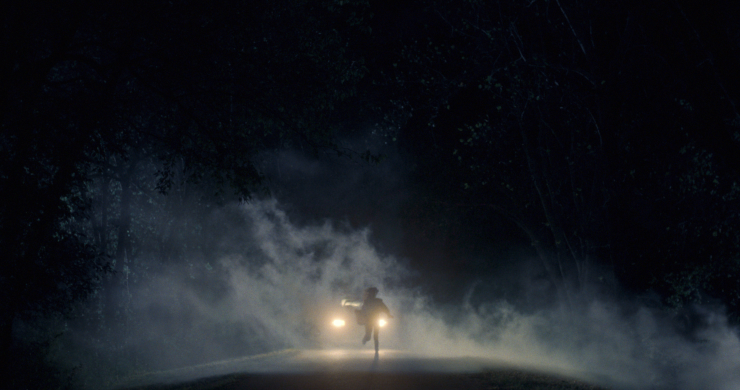
Despite the pacing, there are visual elements that kept me intrigued. In the first act, there are several flashbacks that all take place within the camper, making you wonder if Lena has been here before. Body horror is a small but effective component that made me cringe. We see what’s happening inside Lena’s body, whether it’s from the supposed infection or something else, and I thought that was cool. It makes you fret for your own body with her.
And as I’ve mentioned before, practical effects are always appreciated, and Hellcat uses them effectively, especially in the climax. That’s a big spoiler so that I won’t go into details.
But I will say it was a little bit of a disappointment. I was expecting this big reveal with a possibility of a lot of practical effects when, in reality, it was very… small (if you know, you know).
I prefer not to disclose too many specifics about the genre of this movie, because if I had known earlier, I might have been agitated. The direction is unique, and I do appreciate that. However, it didn’t fully capitalize on its potential and could have been more ambitious in its execution.
The story is intriguing, and the performances are excellent. If you can appreciate an indie film that demands a bit of patience, you’ll enjoy this one.
I give Hellcat a two out of five stars. The film drags on too long before delivering the main reveal, and when it finally comes, the payoff doesn’t justify the wait. Typically, I consider myself a rather patient horror fan — someone willing to endure slow builds and atmospheric tension — but this movie tested my limits.
Perhaps my disappointment stems from a misconception: I entered the film expecting a traditional horror experience. Maybe I was hoping for more jump scares, intense sequences or a clearer sense of danger. Was I setting my expectations too high? Or was I simply misaligned with what the movie aimed to deliver? In the end, it left me feeling underwhelmed and somewhat frustrated.
Hellcat did make me feel a sense of claustrophobia, and perhaps that worked against it. Discomfort combined with a slow burn resulted in a dragging runtime, leaving me eager for the credits to roll.
Maybe I would have been more scared if balloons were involved.