
There are moments in life when your brain decides it has had enough of reality and just wanders into fantasy without asking permission. It is not that I am bored. It is just that the world sometimes needs a little glittery nonsense sprinkled on top to get through the day. Years of movies and late-night caffeine have convinced me that musical numbers should be allowed to erupt anywhere, at any time.
That whole impulse kicked in harder than usual last weekend. Grey and I were sprawled out on the couch, eating popcorn that had basically become a butter and salt delivery system, and she suggested we take turns describing our lives in musical form. Hers involved being a lightning-powered dragon princess. Mine involved leading a group of misfits in a neon-soaked prison break, complete with synchronized tap dancing and a dramatic spotlight that followed me around the room. It was goofy and fun and one of those tiny creative moments that ends up setting the tone for the rest of the night.
As soon as we wrapped up our fantasy performances, I realized the vibe lined up perfectly with the movie waiting next in the queue.
Kiss of the Spider Woman (2025) is a glittery and gritty musical drama that blends political imprisonment with old-school Broadway-style escapism. Adapted from the stage musical, the film follows Luis Molina (Tonatiuh), a queer window dresser serving time in an Argentine prison during the era of dictatorship. His cellmate is Valentín Arregui (Diego Luna), a revolutionary who is not exactly thrilled to be sharing a cramped cell with someone who escapes into lush imaginary movie worlds the way most people bury themselves in daydreams.
Those fantasies revolve around glamorous screen diva Aurora (portrayed by Jennifer Lopez), who becomes the star of the elaborate musical numbers that Molina uses to emotionally survive the bleakness surrounding him. The film becomes a tug of war between hope and despair, fantasy and hard reality, showing how two very different men slowly begin to understand each other.
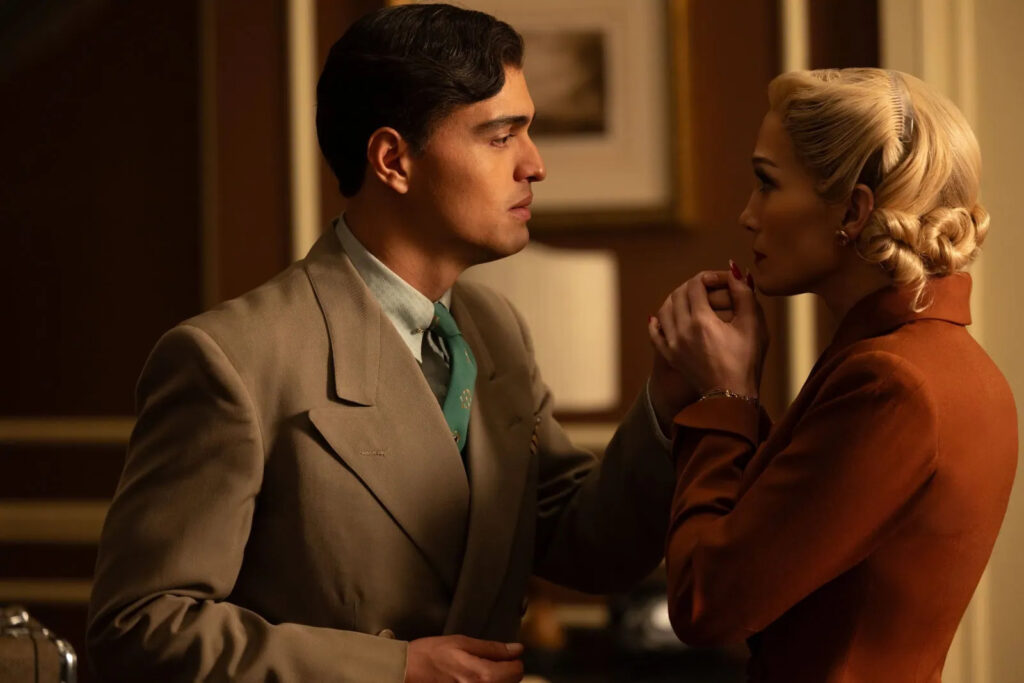
What immediately stands out is the film’s willingness to go big. Jennifer Lopez absolutely commands every inch of the frame whenever Aurora appears. She steps into this role like it was custom built for her from the ground up. Every costume looks like it belongs in a museum. Every dance sequence feels like it was resurrected from golden age cinema and polished until it gleamed. Lopez brings a level of theatrical intensity that gives the film its pulse.
These dream sequences are vibrant and dramatic and designed to be larger than life, and they function as lifegiving oxygen for both Molina and the viewers.
Tonatiuh, however, gives the film its heart. His performance is tender, vulnerable, expressive and grounded in a way that prevents the character from ever drifting into stereotype. You can feel every beat of Molina’s fear, joy, loneliness and longing. His chemistry with Diego Luna becomes the heart of the story. As Valentín slowly shifts from cold and guarded to gradually understanding the emotional world Molina creates, the film finds its most human moments. Tonatiuh pulls off something tricky here: He makes Molina’s fantasy life feel not just believable, but necessary.
When the film leaps into those musical dreamscapes, it feels earned because he has shown you why Molina needs them.
The design work throughout the film deserves praise, as well. The contrast between the harsh, confined prison environment and the glowing fantasy world is both visually striking and thematically meaningful. The dream sequences open up like a breath of fresh air, filled with color and movement. It becomes immediately clear how Molina uses beauty as a weapon against despair. As someone who enjoys world building, whether in movies or in tabletop gaming, I found this contrast compelling and satisfying.
Not everything clicks the way it should, though, and the biggest issue is that same tonal shift between fantasy and reality.
The transitions can feel awkward and abrupt, which sometimes pulls the viewer out of the experience rather than enhancing it. It is almost as if the film wants to be two different genres at the same time and never completely finds the perfect balance. There are also moments when Valentín’s political story feels underdeveloped, compared to the elaborate dream numbers. The pacing can be uneven, too, with certain moments rushing by while others linger longer than needed.
None of this ruins the film, but it does keep it from reaching the emotional impact it clearly aims for.
I give Kiss of the Spider Woman three out of five stars. Even with its flaws the film remains a fascinating and heartfelt piece of work. It is ambitious and stylish and carried by two standout performances that make even the uneven moments worth sitting through. It may not always blend its elements as smoothly as it wants to, but when it finds its rhythm, it delivers powerful emotional beats and some memorable musical flourishes.
It is these very reasons this movie was an instant sellout at the recent Nashville Film Festival (where Tonatiuh was awarded the Rising Star Award).
Watching the film actually reminded me of that silly night on the couch with Grey. Life is a strange combination of routine and imagination. We all have our own little escape hatches, whether they involve dragon queens or neon-lit musical prison breaks, or just daydreaming in the middle of a meeting. Molina escapes into movies. I escape by imagining myself dancing on top of a jail cell for no reason, whatsoever. The movie suggests that these fantasies do not merely distract us. They keep us afloat.
And sometimes they are the only thing that gets us through the moments that feel too heavy to carry on their own.