There’s a part of me that has always thought knowing the future would be the ultimate cheat code. No surprises. No wrong turns. No awkward moments where you realize too late that you absolutely should not have said that thing out loud. Just clean, efficient living, armed with foresight, dodging regrets like potholes on I-40. It sounds comforting. Reassuring. Powerful.
And then I actually stop and think about it.
Because knowing the future wouldn’t just mean skipping bad days. It would mean carrying every bad day with you before it even arrives. It would mean watching moments unfold while already aware of how they end, which ones matter and which ones are doomed no matter how much you try to change them.
Hope wouldn’t completely disappear, but it would become fleeting. Heavy. And suddenly that gift starts to feel less like a blessing and more like a curse.
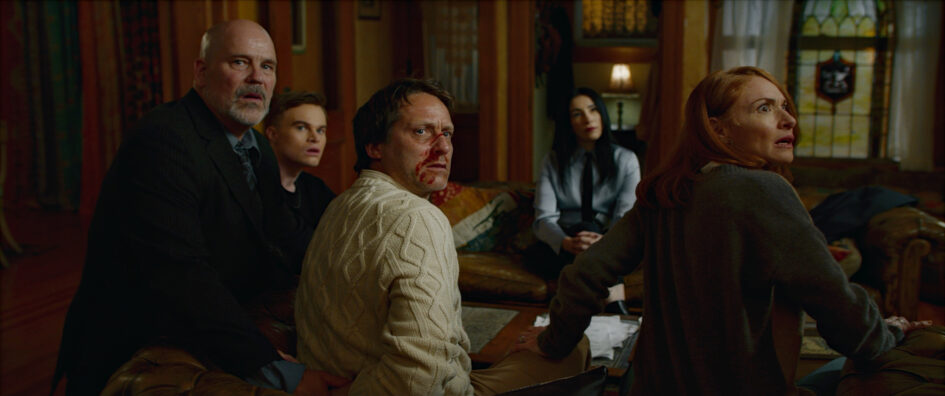
Being able to see the future is the driving force behind The Strange Dark, a sci-fi thriller written and directed by Chris Messineo. The film opens with Maria (Carmen Borla) and Frank (Bates Wilder) arriving unannounced at the home of Susan (Nili Bassman), a woman they claim is the key to finding her estranged husband, Edgar (Caleb Scott). What starts as a tense conversation quickly turns invasive, as the pair make thinly veiled threats about what will happen if Susan doesn’t cooperate, refusing to leave until she gives them Edgar’s location.
What Maria and Frank don’t realize is that Edgar has already seen this moment unfold. After cracking a mysterious universal code, he’s gained fragmented glimpses of the future.
Trapped between a husband she no longer trusts and investigators who feel increasingly dangerous, Susan is forced into an impossible decision: believe the man who claims to know what’s coming, or the ones insisting they already do.

One of the more surprising pleasures of The Strange Dark is that it knows when to let the tension breathe. There are several moments that genuinely had me chuckling, largely thanks to the sharp, understated chemistry between Frank and Maria. Their back-and-forth carries a dry, lived-in humor that feels intentional rather than quippy, recalling the comedic rhythm of Martin Riggs and Roger Murtaugh in the Lethal Weapon franchise. It’s not joke-heavy or attention-seeking, but the kind of low-key banter that makes the characters feel human, and more importantly, makes their more sinister moments land even harder.
Another major strength of The Strange Dark is how effectively its production design expands what is essentially a single location. The space never feels stagey or confined, thanks in large part to the way the film is broken into distinct “scenes,” each replaying the events of the evening from a different point of view. Rather than feeling repetitive, this structure deepens the experience, subtly shifting context and emotional weight with each revisit.
This approach gives every character room to breathe. Each perspective adds new information, allowing motivations and histories to surface naturally instead of being forced. As a result, the audience gains a clearer understanding of why these characters behave the way they do, and how their personal baggage shapes the choices they make. It’s a smart narrative device that makes the film feel bigger, richer and more layered than its limited setting would suggest.
However, the film isn’t without its drawbacks. While Maria and Frank are undeniably charming and share an easy, believable chemistry, the same can’t be said for Susan and Edgar. For a married couple (even one on the verge of divorce), there’s surprisingly little sense of a shared history or an emotional bond between them. That absence makes it hard to fully buy into the moments where their “love” begins to resurface, as it feels more like a narrative requirement than an organic emotional shift.
Edgar, portrayed by Caleb Scott, is also a sticking point. While it’s clear that some of his eccentricity is intentional, his portrayal often veers too far into the kooky to feel credible. For someone desperate to convince his wife that what he’s experiencing is real, Edgar comes across as scattered and chaotic, undermining the urgency of his claims. The way he explains his visions lacks the quiet conviction you’d expect from someone who truly believes in what he’s uncovered, making it harder for both Susan and the audience to place their trust in him.
In the end, The Strange Dark earns a solid three and a half stars out of five, thriving at its best on sharp dialogue, unexpected humor and a smart structural choice that allows the same night to unfold through multiple perspectives, enriching both the tension and the characters. The strong chemistry between Carmen Borla’s Maria and Bates Wilder’s Frank, paired with thoughtful production design, makes the film feel far larger than its single setting, even as its weaknesses circle back to that central question of foresight.
Knowing the future doesn’t automatically make things clearer, calmer or easier, and the film occasionally struggles to make its emotional stakes feel convincing.
By the end, The Strange Dark circles neatly back to that opening temptation of wanting to know what comes next. Edgar’s glimpses of the future suggest that foresight can make a difference, that it might even help save the day, but only at a cost. Getting to the right outcome isn’t clean or comforting, and knowing the destination doesn’t spare anyone the bruises along the way. If anything, it makes the journey heavier, filled with doubt and a few surprises that no vision can fully prepare you for.
The film leaves you with the uneasy realization that seeing the future doesn’t eliminate the pain of living through life. It just makes you aware of every step along the way.