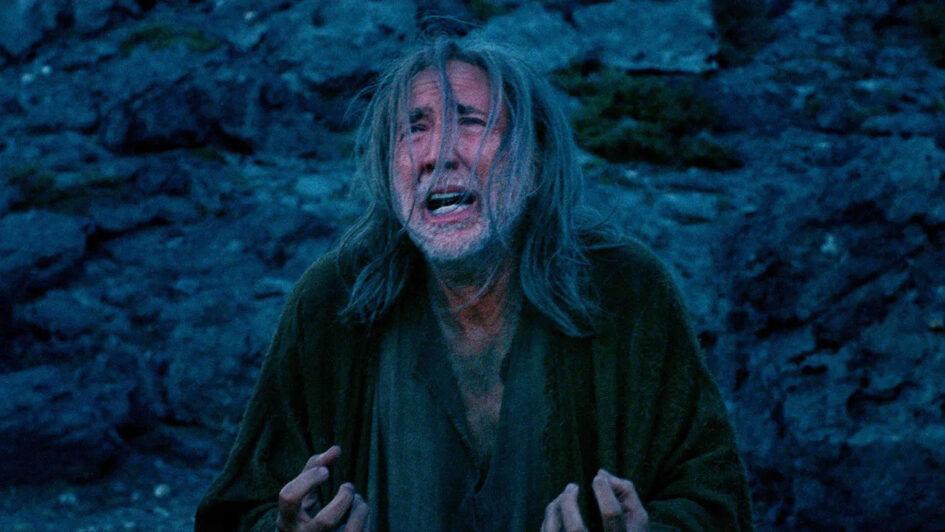
I have reached the point in my moviegoing life where I no longer believe Nicolas Cage can take a bad role. Not because every film he appears in is great, but because Cage, himself, refuses to be boring. He does not simply act. He commits. Every role, no matter how strange or small, feels like something he has chosen with intention, even when that intention is pure chaos.
Basically, Nicolas Cage is my cinematic spirit animal. If his name is on the poster, I am in. No trailer. No plot summary. He treats every role like it matters, and in an industry that often coasts on autopilot, that kind of sincerity is rare.
That is what makes The Carpenter’s Son such an immediately compelling proposition. A biblical horror film centered on the childhood of Jesus is already a risky swing, but adding Nicolas Cage into that equation feels less like casting and more like a dare.
Written and directed by Lotfy Nathan, The Carpenter’s Son draws from the Infancy Gospel of Thomas to reimagine the childhood of Jesus through a much darker lens. The Carpenter (Nicolas Cage) and his wife, The Mother (FKA twigs), give birth in a cave and are immediately forced to flee as King Herod’s guards burn children in the streets, searching for any boy who might threaten his rule.
Years later, the family lives in exile in Egypt, surviving as nomads while The Carpenter grows increasingly fearful that anyone who witnesses his son’s “gifts” will see them as something to condemn, rather than revere.
Now a teenager, The Boy (Noah Jupe) struggles under strict rules and constant prayer, his curiosity straining against his father’s control. He becomes drawn to Lilith (Souheila Yacoub), a mute girl who he becomes enamored with, and The Stranger (Isla Johnston), a scarred young woman who introduces him to horrors he never knew existed, while helping him explore his abilities (sometimes without his consent).
As those powers grow more unsettling, The Carpenter clings to the visions he once believed foretold his son’s goodness but is left facing a terrifying possibility: that the child he is raising may be destined for something far more dangerous than salvation.

Cage’s portrayal of The Carpenter (we all know he is Joseph, but the film wisely lets the title do the talking) is one of the most quietly unnerving performances he has given in years. This is not Cage at full volume, chewing scenery like it owes him money. Instead, he plays the role as a man hollowed out by responsibility, deeply loving his son but terrified that God has handed him something he was never meant to control.
Cage lets the fear sit in his eyes, in the way he hesitates before touching the boy, and in the heavy silences between prayers. It is a reminder that when Cage dials it back, he can be far more frightening than when he explodes.
The film’s greatest strength, aside from the glory that is Cage, is its atmosphere. Nathan shoots the ancient world as a place of dirt, blood and shadow, where faith is not abstract but brutally physical. Miracles are not wondrous spectacles here. They are accidents. Burdens. Events that leave people staring in silence, unsure whether to kneel or run. The sound design leans into whispers, wind and distant screams, making the divine feel invasive rather than comforting.
What makes The Carpenter’s Son work as horror is its refusal to offer easy answers. It does not position belief as good or evil. Instead, it shows belief as dangerous when mixed with fear, secrecy and authority. Adults project meaning onto the child Jesus, while he, himself, remains confused, frightened and increasingly isolated. The film understands that horror does not come from demons or monsters, but from adults forcing a child to find solace somewhere he is not ready to go.
This is not a fast-paced film, and that will turn some viewers away. It lingers. It broods. It trusts silence more than dialogue. But that patience allows the tension to grow naturally, like rot beneath holy imagery. When violence arrives, it feels inevitable rather than shocking, the result of faith pushed past its breaking point.
If there is a flaw, it is that the film risks alienating both religious audiences and mainstream horror fans at the same time. It is too unsettling to function as inspirational cinema and too restrained to satisfy viewers looking for constant scares. But for those willing to meet it on its own terms, it is one of the more thoughtful and unsettling horror films of the year.
I give The Carpenter’s Son four out of five stars. It is not interested in tearing down faith. It is interested in what happens when faith becomes responsibility, when miracles stop being gifts and start becoming burdens. Anchored by a haunting performance from Nicolas Cage, it is a slow-burning meditation on fear, devotion and the cost of divine purpose.
Faith is complicated. Miracles are dangerous. Parenting is terrifying. And Nicolas Cage, once again, proves that he is operating on a higher cinematic plane than the rest of us. If this is not holy work, I do not know what is.