When I sat down to watch Warfare, I could not help thinking about the stories my dad used to tell me about his time in the Army Air Forces during World War II. He flew missions over Germany, navigating the sky under fire while somehow keeping his nerves steady. As a kid, I never completely grasped the dangers he faced. I only knew that my dad climbed into those planes again and again, doing a job that could have kept him from ever coming home.
Yet he did come home. He returned not as a hardened warrior, but as the warm-hearted man who later spent years building cabinets in the garage, sanding wood with quiet patience and humming along to country music on 650 AM WSM. I admired how he managed to go off to war and still return as someone capable of being a loving father, a steady guide and a man whose hands built both furniture and a family.
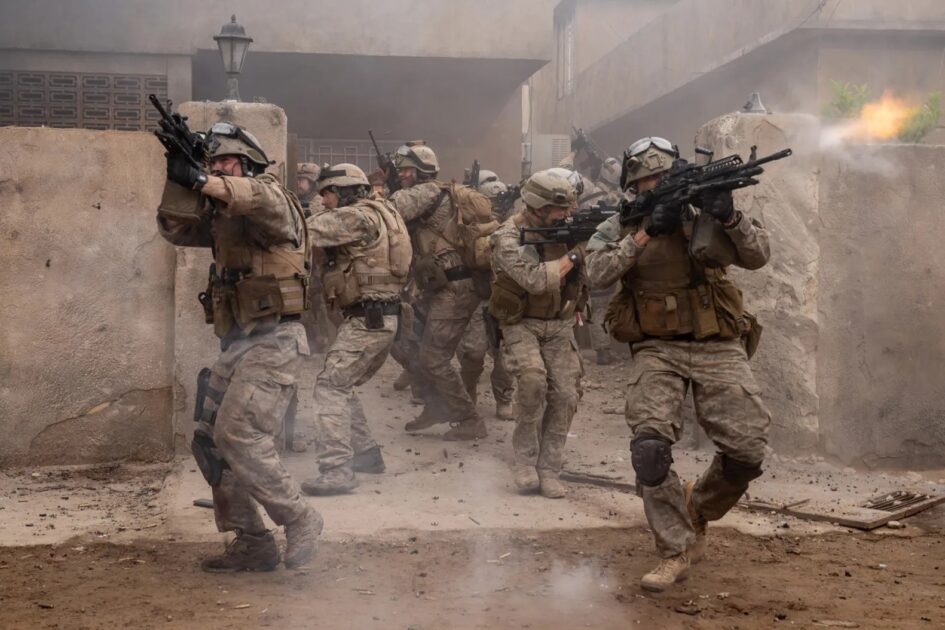
That personal history always sits with me when I watch modern war films. Some movies try to glorify combat, others try to condemn it, but I am often looking for a spark of human truth in the middle of the chaos. Warfare, co-written and co-directed by Ray Mendoza and Alex Garland, approaches its subject from a different angle. It focuses on a single mission in Ramadi, Iraq, unfolding in real time over the course of one intense night.
Based heavily on the testimonies of men who were actually there, the film aims to replicate the immediacy of that memory, rather than shaping it into a traditional narrative arc. It is a visceral experience, one designed to make you feel the tension of every corner turned and every shadow that might conceal danger.
On one tense day in 2006, SEAL platoon Alpha One storms a small house in Ramadi. Lieutenant Erik (Will Poulter) and JTAC officer Ray Mendoza (D’Pharaoh Woon-A-Tai) moves through the tight rooms alongside lead sniper Elliott Miller (Cosmo Jarvis) and fellow sniper Frank (Taylor John Smith). At first, their goal is simple: secure the location and hold it. But it does not take long for insurgents to mobilize outside, tightening a circle around the team.
What starts as a routine mission becomes a desperate stand as Alpha One realizes they are isolated, outnumbered and waiting for backup that may not arrive in time. The real question becomes not whether they can hold their ground, but how much of themselves they will lose in the process.
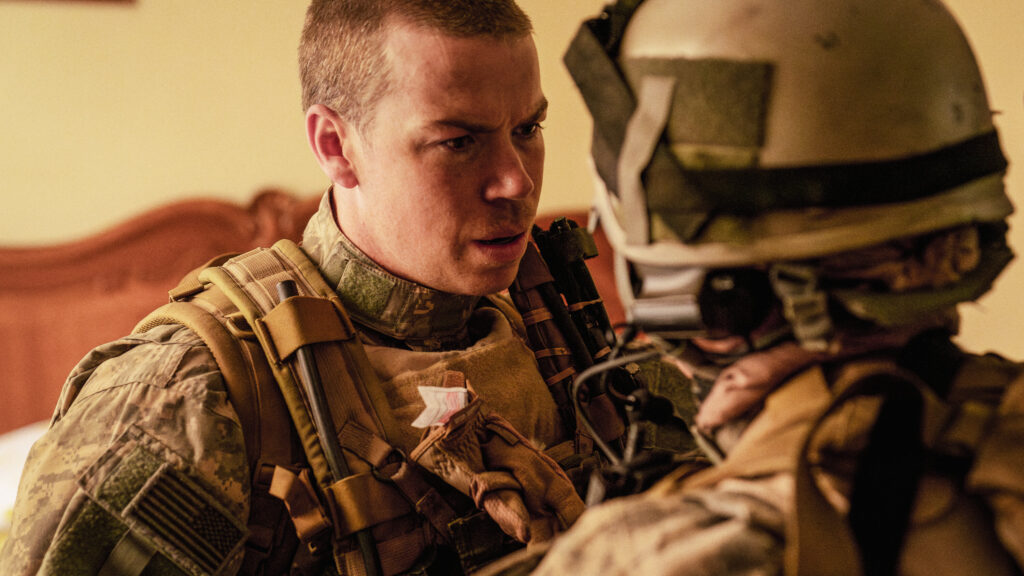
In terms of craft, the film is undeniably impressive. The cinematography pushes you into cramped rooms, smoke-filled corridors and the harsh, sand-coated streets of a hostile city. The camera rarely gives you space to breathe, mirroring the claustrophobic panic of urban warfare. The sound design is even more unrelenting. Gunfire cracks with startling realism, radios buzz and fail, explosions thump your chest, and the low moans of injured soldiers echo longer than you might expect.
The cast, led by D’Pharaoh Woon-A-Tai with strong support from Will Poulter, Cosmo Jarvis and others, plays everything with tight control. They never chew scenery and never make their characters feel like stereotypes. Instead, they bring a rawness that fits the film’s intent to strip away theatrics.
Yet for all of its technical strength, Warfare can feel emotionally distant.
The real-time approach means we get almost no personal backstory and very little insight into who these men are, beyond the mission. There are no scenes of home, no families waiting, no glimpses of what these soldiers will return to, if they survive. By choosing not to include that emotional grounding, the film traps you in the moment but never encourages you to invest in the men beyond the moment. This might be intentional.
War often erases long-term thinking and reduces every decision to the next 10 seconds. Still, the result is a film that is powerful to watch, but difficult to connect to, on a deeper level.
This contrast is what stood out most to me. When my dad told me his war stories, they were not polished. They did not come with dramatic conclusions. Sometimes he would pause midsentence, stare off for a moment, and then shrug before going back to staining a cabinet panel. But even when his stories were fragmented, I always understood the emotional core that shaped the man he became. Warfare captures the fragmented feeling of war, but not the emotional aftershock. That separation makes the movie feel honest in one way and hollow in another. It recreates the experience with accuracy, yet it rarely reflects on the weight that experience leaves behind.
There are moments in the film that come close to breaking through. Small glances between soldiers, quiet breaths between firefights, the rare flicker of vulnerability in an otherwise hardened face. But those flickers never have room to grow. The film ends abruptly, transitioning into real footage of the men portrayed by the actors, which adds authenticity, but not closure. It feels like the movie wants to honor the real mission while pulling back from making any larger statement about war itself.
The restraint is admirable, yet it also limits the emotional resonance the film might have achieved.
Despite those shortcomings, I respect what Warfare sets out to do. It is unflinching, immersive and crafted with obvious care from people who understand the stakes. It is not a sweeping war epic or a moral commentary. It is a snapshot. A window into a night that looked very different from the wars my dad experienced but still echoes the same fear and uncertainty he carried with him long after he stopped flying missions.
In the end, I give Warfare three out of five stars. It is a film I admire more than I love. Its technical achievements are undeniable and its authenticity is potent, but it stops short of delivering the full emotional journey I hoped for. It left me with a heightened appreciation for the chaos soldiers endure, but also with a longing for the human depth that makes war stories endure beyond the battlefield.
My dad found that depth in the life he built once he returned home. Warfare shows us the storm, but rarely the calm that follows.