
I’ve always believed movies should entertain, first and foremost. Whether it’s a goofy comedy, a bone-chilling horror flick or a sweeping epic, the primary job of a film is to grab you, keep your eyes glued to the screen, and make you feel something. Everything else — the history, the message, the moral weight — comes second. If a film can’t pull me in as a viewer, then its lessons, no matter how important, won’t land.
Some movies exist to entertain, others to haunt you long after the credits roll. 731 (also known as Evil Unbound) is firmly in the latter category. The film dramatizes the atrocities committed by the Japanese Imperial Army’s Unit 731 during the late 1930s and early ’40s, a subject that has rarely been explored with this level of intensity outside of documentaries and grindhouse horror. Instead of leaning on cheap shocks, 731 grounds its horror in historical truth, making the viewing experience all the more harrowing.
In 731 (Evil Unbound), director Linshan Zhao drops viewers straight into 1945 China, where the Japanese Army has established what they claim is a “water supply and epidemic prevention unit” in the Pingfang District. To the unsuspecting locals, it sounds like a mission of public health, but behind the walls lurks something far more sinister. Among those lured into service is Wang (Wu Jiang), a street vendor who, like many others, believes he is contributing to something beneficial. Instead, he finds himself trapped inside a nightmare, as the unit’s true purpose — grotesque biological experiments on innocent civilians — slowly comes to light. What follows is a descent into cruelty and atrocity beyond anything Wang could have ever imagined.
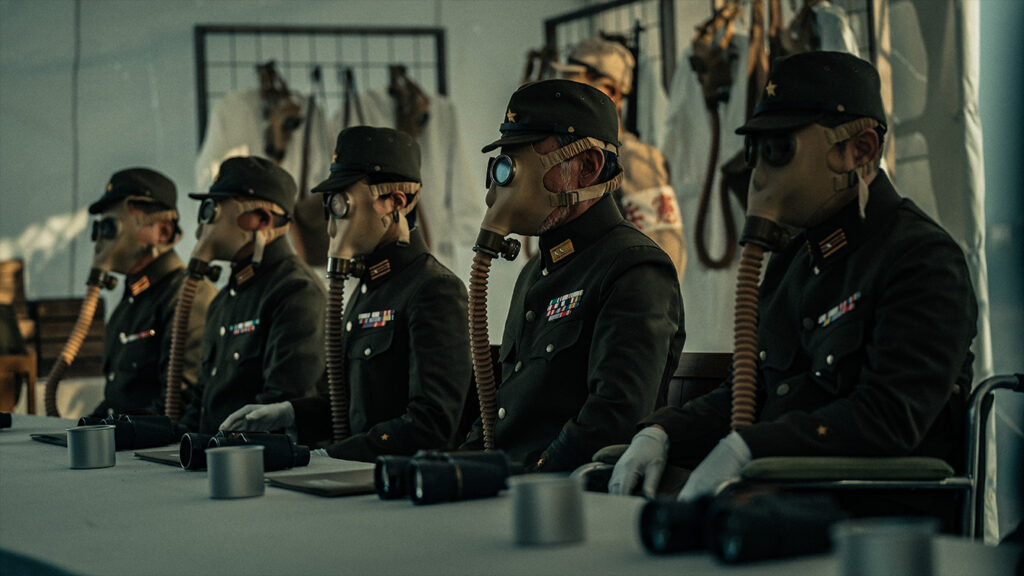
The film does an effective job of showing us the true evil of the army without turning its characters into caricatures of Dr. Evil from Austin Powers. Yes, there are villains — scientists and officers who treated human beings like lab rats — but the script also gives space to those caught in the machinery, struggling with the guilt of complicity. By centering on Wang, an “ordinary” person, the story gives viewers someone to follow, someone to feel for, in the middle of a nightmare that could otherwise feel too vast to comprehend.
It’s in those quiet moments that the movie really lands its emotional punches.
Technically, the film nails its atmosphere. The cinematography is cold and clinical, and the production design makes you feel like you’ve been dropped into a facility where death is just another experiment. There’s no attempt to glamorize the setting in any way. Instead, the visuals mirror the bleak coldness of the history itself. And while the film doesn’t shy away from graphic imagery (one “degloving” scene has stuck with me ever since I saw it),
it rarely feels gratuitous. It wants you to be horrified, yes, but it also wants you to think about what it means that this really happened.
That said, 731 isn’t without its flaws. The pacing wobbles, especially when the script tries to explain the scientific and political context. At times it feels less like a drama and more like a lecture, and the film occasionally struggles to decide just how much horror the audience can take. Some scenes feel like they pull back too abruptly, as though the filmmakers couldn’t quite commit to staying in the darkest corners of history. It doesn’t ruin the experience, but it does create an uneven rhythm. And for me, it made some parts of the film feel incomplete.
I can’t help but wonder if some of what I read as flaws may actually come down to cultural differences. I’ll be the first to admit that I’m not well versed in the traditions of Japanese filmmaking. My viewing background is rooted primarily in American cinema, with only a handful of experiences dipping into other cultural film styles. Because of that, the abrupt cuts, tonal shifts and pacing choices in 731 might not be mistakes at all — they could simply be hallmarks of a storytelling rhythm I’m not accustomed to. What feels jarring to me as a Western viewer might come across as completely natural, even deliberate, to someone more familiar with Japanese cinematic language. It’s a reminder that film is a cultural artifact as much as it is entertainment, and sometimes our perspective, as outsiders, shapes how we interpret what’s on screen.
It’s worth noting that 731 may stir up plenty of controversy, once it reaches wider audiences. The subject matter alone — the Japanese Imperial Army’s human experimentation and war crimes — is enough to spark heated debate, but the way the film visualizes these atrocities will divide viewers even further. Some will argue it’s necessary to confront this history head-on, while others will see it as exploitative or sensationalizing real suffering. And beyond artistic debates, the film could reopen old political wounds between Japan, China and the global community, making 731 not just a movie, but a flashpoint for discussion about memory, responsibility and how far cinema should go when depicting history’s darkest corners.
I give 731 three out of five stars. It’s not the kind of movie you watch for fun, but it is one you watch because it matters. By putting a human face on one of the ugliest chapters of history, it ensures the victims of Unit 731 aren’t forgotten. This isn’t just a history lesson — it’s a reminder of how fragile our humanity can be when ideology and cruelty take over.
Watching it left me shaken, but also grateful that cinema can still force us to confront truths we might rather ignore.