I have always had a soft spot for stories that take something familiar and twist it just enough to make it feel new again. Give me a reimagined fairy tale, a sideways sequel, a villain-centric prequel and I am all in. There is something fun about seeing a classic world from a completely different angle. That is why I love films and plays that take traditional stories and crack them open.
Some of my all-time favorites in that category are reinterpretations of The Wizard of Oz, like The Wiz and Wicked, along with Disney’s Maleficent. Each takes a story we think we know and challenges the old assumptions, digging deeper into the ideas of identity, morality and myth. It is why I perk up whenever a movie promises a new take on a classic myth, especially one as iconic as Dracula.
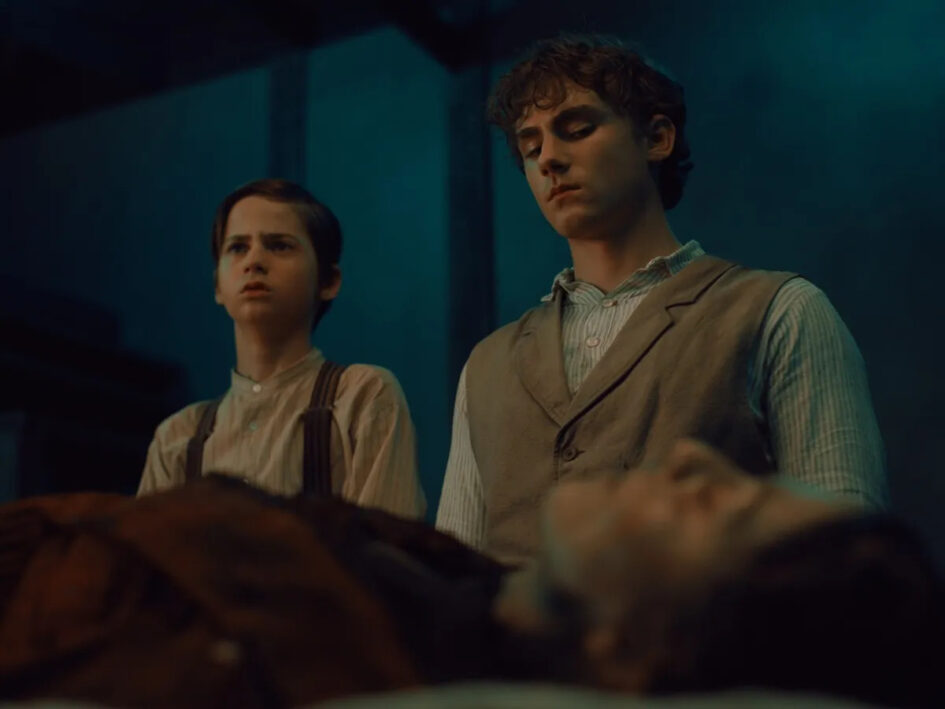
Abraham’s Boys: A Dracula Story (2025) is a horror film written and directed by Natasha Kermani. Based on the Joe Hill short story, it’s set almost 20 years after the events of Dracula. Dr. Abraham Van Helsing (Titus Welliver) has settled in California with wife, Mina Harker (Jocelin Donahue). They’ve built a quiet life with their two sons, Max (Brady Hepner) and Rudy (Judah Mackey), but the shadows of their past never fully let go.
The boys have grown up listening to their father’s tales of monsters and bloodshed, and when Max finally reaches the age Abraham deems appropriate, he is pulled into the family business. At the same time, Mina begins behaving strangely, a shift Abraham immediately interprets as the return of an old darkness.
That darkness soon appears in the form of Pacific Railroad surveyors who seem far more menacing than they initially appear. As the family braces for the coming threat, Max and Rudy begin questioning everything they have been taught. They aren’t sure if the evil is influencing them or if their father is keeping secrets of his own.
Unlike most vampire flicks, Abraham’s Boys leans into family drama and the heavy legacy of Van Helsing, instead of relying on nonstop gore or flashy monster moments. Kermani focuses on what it means to grow up in the shadow of a legendary hunter, where trauma becomes bedtime stories and fear becomes family history. Rather than chasing bloodshed, the movie settles into the tension inside the home, exploring how Abraham’s paranoia shapes the boys, how Mina’s struggles haunt her in ways no vampire ever could and how the children wrestle with whether they’re inheriting a calling or a curse.
The horror simmers quietly beneath guilt, distrust and the weight of a legacy none of them asked for.
The idea of sons raised by an isolated, secretive father who has dedicated his life to hunting the darkness has a lot of potential, and it might be the film’s most interesting thread. Watching Max and Rudy grow up under rules they never fully understand — taught to distrust outsiders, taught that danger is everywhere — should have been fertile ground for tension. Abraham’s paranoia becomes the air they breathe, twisting their sense of trust and identity. The boys want to believe their father. They want to protect their family. But they can’t shake the feeling that they’re being prepared for a war that may exist only in Abraham’s mind.
That push and pull is rich territory for horror, especially when dealing with someone as mythic as Van Helsing.
However, for a film that runs only 90 minutes, it manages to feel much longer. The pacing drags through long stretches where almost nothing meaningful happens. The movie lingers in silence and atmosphere, which can be effective in a mood-driven horror piece, but here it frequently slips into stagnation. Scenes unfold at a crawl, characters stare into the distance for what feels like forever and the story repeatedly hints at revelations without ever delivering them in a satisfying rhythm.
Instead of building suspense layer by layer, the film gets stuck in place. Even when the action finally arrives, the slow pacing has already drained the momentum.
The film also struggles to decide what kind of story it wants to tell. At times it embraces supernatural horror with hints of vampires and creeping shadows. At other times it becomes a moody family thriller centered on paranoia and unraveling trust. Blending genres isn’t the issue. The problem is that the movie never commits to a clear tone. The two directions keep pulling against each other, making the story feel unfocused and the tension diluted.
I give Abraham’s Boys: A Dracula Story two out of five stars. It never quite settles into a confident reinterpretation of the Dracula mythos. Sometimes it leans toward supernatural horror, sometimes toward psychological drama, but it never decides which version of itself it wants to be. And for someone like me — someone who loves fresh twists on classic tales — the film ends up being the opposite of what I enjoy most.
The ingredients for a bold reinterpretation are there, but the movie lacks the clarity and conviction that make those kinds of retellings truly shine.
Jason Kittrell
Jason Kittrell is a member of the Music City Film Critics Association and he's also active within the horror community.