I have a long, complicated history with group projects. Not the school kind, where some kid named Kyle shows up with nothing but a Capri-Sun and the confidence of a man who did zero work, but the adult kind: meetings, committees and collaborative “events.” Any time more than three humans decide they’re going to “fix a problem” together, it usually takes about five minutes before someone starts arguing or someone else starts Googling whether feral animals can form unions.
So, it feels spiritually appropriate that Bugonia is a movie about people who absolutely should not be in charge of saving anything, let alone the entire world. I went in knowing almost nothing about director Yorgos Lanthimos, but it became very clear, very quickly, that this was someone who looks at human behavior with the same mix of fascination and anxiety I feel when watching people attempt to assemble IKEA furniture without instructions.
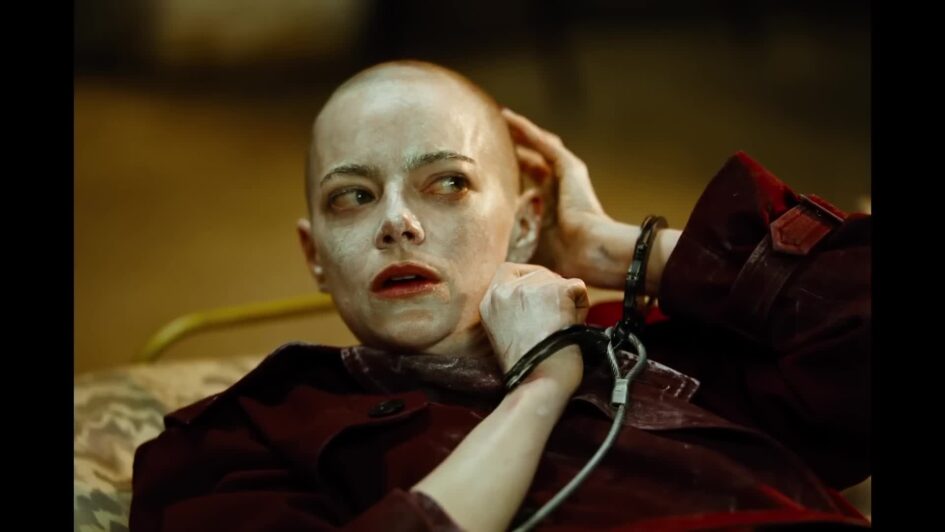
The plot follows two conspiracy-driven environmental extremists, Teddy and his cousin, Don (Jesse Plemons and Aidan Delbis), who kidnap a powerful CEO named Michelle (Emma Stone) because they believe, without hesitation, that she is an alien plotting humanity’s destruction. Not a metaphorical alien. A literal one. Their mission is half activism, half paranoia and all misguided confidence.
Michelle becomes the calm center of their storm, a poised corporate figure who seems almost unreasonably composed for someone duct-taped by strangers convinced she’s from outer space.

With Stone as the CEO, the story’s emotional geometry clicks into place. She plays the abducted executive with a chilling level of composure. She is unflappable. She is polite. She is strategic. She is way too good at adjusting to captivity, which instantly makes her the most intriguing person on screen. Is she terrified? Manipulating the situation? Actually not human?
Her performance, alone, keeps the audience guessing all the way to the end.
Jesse Plemons, as Teddy, delivers a slow-burn unraveling that probably deserves its own psychology lecture series. He plays a man armed with absolute certainty and very little self-awareness, a would-be savior who may actually be the most dangerous person in the room. Aidan Delbis, as Don, brings a heartfelt quirkiness to the pair. Don believes his cousin is the smartest man alive, and his autistic condition leaves him easy prey for Teddy’s conviction. Together, they feel like the world’s least qualified rescue squad.
Between the three, there is an odd tension I can’t completely explain. The kidnappers are 100 percent sure Michelle is an alien. Michelle stays calm, cool and collected, as if she has a certificate in crisis negotiation and kidnap survival. And the audience is left floating between them, unsure who is right or wrong. Watching their interactions is like watching a three-person chess match where no one knows the rules, but everyone keeps insisting they’re winning.
Bugonia is ultimately about belief, specifically the belief that we, alone, understand what’s really going on. The extremists think they’re saving humanity. The CEO thinks she’s the logical one in a room full of emotional fools. Everyone is absolutely convinced they’re the protagonist of the story.
The beauty of the film is that it never mocks the desire to do good. It mocks the idea that having good intentions automatically makes you right. Teddy and Don are misguided, but not heartless. Michelle is brilliant, but not trustworthy. No one here is evil; they’re just disastrously human. It’s a satire of certainty, conviction and all the ways people build elaborate belief systems on top of emotional quicksand.
The humor in Bugonia sneaks up on you. Instead of big jokes or dramatic reactions, the film leans into discomfort. Long pauses. Stilted dialogue. People saying absolutely unhinged things in calm voices, like they’re placing an order at a drive-thru. At first it’s bizarre. Then it becomes addictive. The movie doesn’t wink at the audience. It doesn’t signal punchlines. It just lets the absurdity of human logic (and illogic) hang in the air long enough to make you laugh, cringe or both.
Not knowing Yorgos’ earlier work, I was surprised by how quickly he pulled me into his world. The visual style is perfectly off-kilter: clean, symmetrical, sometimes cold, sometimes dreamlike. Conversations are framed in ways that amplify their awkwardness, tension or absurdity.
The pacing feels deliberate and unusual. Scenes stretch a little longer than expected, and the camera lingers just a moment past the emotional comfort zone. It gives the whole film a sense of eerie calm, even when the characters are spiraling. I didn’t know filmmakers were allowed to be this strange in 2025, but I’m glad someone is still taking big swings.
Bugonia earns four out of five stars. It is the cinematic equivalent of watching three people assemble a bomb they insist is a birdhouse. It is funny, unsettling, layered and endlessly interesting. It’s a movie about people who want to save the world but have absolutely no idea what they’re doing, which honestly feels like the most accurate portrayal of humanity I’ve seen in a long time. Some viewers will demand clarity. They will not get it. Others will thrive on the ambiguity. I happen to be in that group.
The final act shifts the ground beneath the audience’s feet. Nothing flips in a cheap twist way; instead, the film slowly rearranges your understanding of every character’s certainty. It ends in a place that invites discussion, argument and possibly a few conspiracy boards of your own.
Experiencing it without any prior knowledge of Yorgos Lanthimos’ other films made it even more exciting. I wasn’t comparing it to earlier works or waiting for familiar signatures. I was just letting the weirdness unfold, and it absolutely worked on me.
Bugonia is sharp, strange, thoughtful and quietly chaotic. A film about certainty, delusion and the dangerous things people do when they’re absolutely sure they’re right.