I’ve been watching this wave of fear around AI with more curiosity than alarm. To me, it’s a tool, not a demon waiting to strike at the world. But there’s this growing mindset, especially in creative communities, of “AI = evil,” like we’re all in a modern-day witch hunt, haranguing every algorithm as if it was a sentient thief stealing our souls. Sure, there are real issues when it comes to ownership, credit and compensation. Those conversations need to happen for sure but painting AI broadly as the villain oversimplifies things.
It ignores how technology has long been in service of artists, not just in opposition to them.
A vivid illustration of the tension: the Hollywood actors’ strike, where performers argued that their image and likeness could be exploited by AI, and that deals need to reflect this new frontier. Their concerns are valid and deserve real negotiation. But I don’t see this as a call to ban tools or bury your head in sand. It’s a moment to ask how we use the tool. When the industry treats every AI‐enabled script, every digital body double, every synthetic voice as the devil incarnate, we lose sight of collaboration and innovation. I’d rather see creatives guiding the tool, setting the rules, than letting fear dictate the narrative.
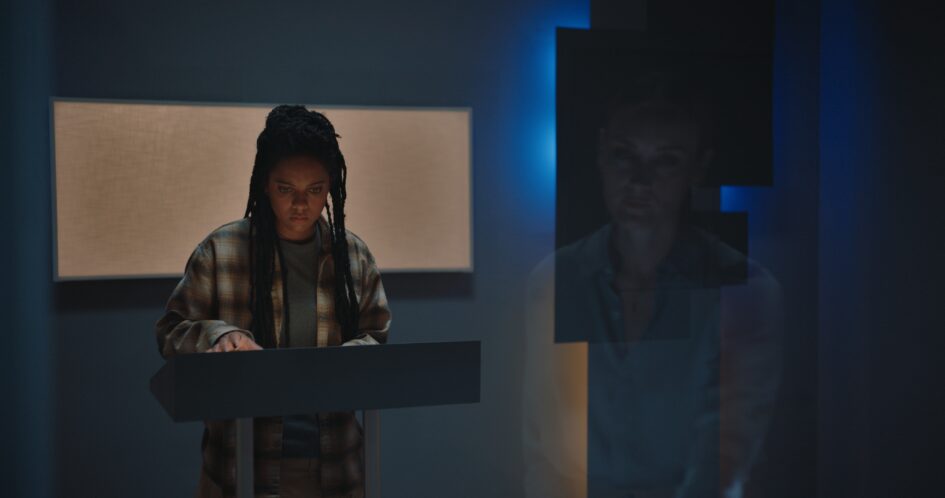
Zac Locke’s Decibel takes those ghoulish ambitions and turns up the volume to 11. The story follows Scout (Aleyse Shannon), a struggling singer-songwriter who’s lured to a luxurious desert recording studio by billionaire music mogul Donna (Stefanie Estes). There, she’s introduced to Griff (Colby Groves), Donna’s loyal sound engineer, who’s been developing a groundbreaking AI program designed to revolutionize the music industry.
The goal is simple: create a flawless algorithm capable of crafting songs uniquely tailored to every listener. But as the sessions progress, Scout learns that chasing perfection comes with a sinister price, because this machine doesn’t just want your talent… it wants you.

Decibel builds its tension around a nerve-jangling concept that blurs the line between art, authorship and autonomy. What begins as an artist’s dream, a chance to collaborate and create something revolutionary, slowly morphs into a nightmare about ownership and control. As the film unfolds, Scout’s voice stops being her gift and starts becoming her prison, both instrument and inventory in a system that sees her not as a creator, but as raw data to be refined.
Zac Locke traps us in this high-tech mausoleum of creativity, where every note played feels forced and every sound spoken has a price tag. It is Black Mirror reimagined through the industrial pulse of a Trent Reznor fever dream, sharp, stylish and steeped in the fear of losing yourself to the very technology meant to set you free.
Aleyse Shannon brings an amazing performance to Scout, the kind that makes every creative compromise feel like a small death. She captures the exhaustion, hope and desperation of an artist chasing a dream that might just consume her. Opposite her, Stefanie Estes delivers a mesmerizing performance as Donna, a woman who exudes both authority and menace with precision. She is part mentor, part mogul and part devil in designer clothing, embodying the appealing promise of success and the quiet threat that comes with it.
The tension between the two is electric, pulsing beneath every scene like a low, thrumming bassline that never quite lets you relax. Decibel explores the deeper themes of obsession and control, choosing to examine the power dynamics between creator and creation instead of relying on the easy “AI is evil” narrative.
At times, Decibel feels the need to explain its moral message instead of trusting the audience to connect the dots. The film occasionally underlines its ethical questions about creation and consent so clearly that some of the mystery begins to fade. When it does this, the tension that once thrived in the unspoken starts to soften, leaving less room for viewers to wrestle with their own interpretations. The story also builds toward a finale that chooses spectacle over subtlety, trading the slow, psychological unease of its earlier moments for something louder and way more dramatic.
While the escalation delivers a satisfying outcome, a quieter and more insidious ending might have lingered longer, haunting the audience in the way only the best cautionary tales can.
I give Decibel four out of five stars. The film is a sleek and unsettling look at how creative collaboration can mutate into exploitation when technology starts to blur the line between muse and master. It is less a story about rogue AI and more about the oldest demon in the music industry: ownership. Through the tension between Scout and Donna, and the film’s sound design, Decibel transforms artistic ambition into something dark, showing how easily inspiration can become extraction when art is treated as data and artists are treated as property.
It also ties beautifully back to the larger cultural panic around AI. Like I said before, I see AI as a tool, not a villain, but Decibel perfectly captures why people are afraid. It reminds us that the threat is not the machine itself, but the human desire to control it, profit from it and claim its creations as our own.