Ever had a dream that is just completely crazy, yet vivid as a memory? Everything feels normal while it’s happening and only reveals its full insanity the second you wake up. In my dream (and I remember it so well), I was standing in the checkout line at a grocery store that didn’t sell food, just VHS tapes and loose batteries. Everyone ahead of me was arguing about which one of us was supposed to die first, like it was a scheduling conflict.
At some point I realized I was holding a PlayStation controller with no buttons, desperately mashing at nothing while a countdown clock was running overhead. No monsters. No jump scares. Just the creeping understanding that I was playing a game I never agreed to, with rules no one bothered to explain.
That’s usually where I wake up, wondering why my subconscious has such a flair for bleak nonsense. And honestly, it’s the perfect headspace to start talking about Good Luck, Have Fun, Don’t Die.
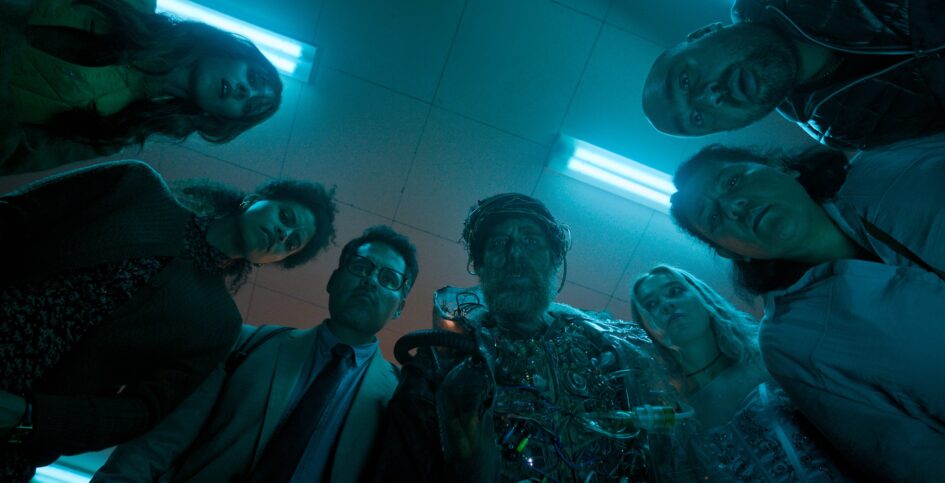
As a sci-fi comedy from Gore Verbinski, this marks his first feature since A Cure for Wellness (2016). The film stars Sam Rockwell as a man who may have traveled back from the future to save humanity (many, many times) or he may simply be deeply unwell and in desperate need of psychiatric care. When he stumbles into a late-night diner wearing a raincoat, grimy clothes and a bomb vest, the line between prophet and madman immediately blurs.
Inside the diner, he recruits a small, very confused group into his mission, including Ingrid (Haley Lu Richardson), Mark (Michael Peña), Janet (Zazie Beetz), Susan (Juno Temple) and Scott (Asim Chaudhry). Their supposed enemy isn’t a demon or a monster, but an artificial intelligence scheduled to be “born” that very night. If it comes online, he claims, humanity’s future is effectively over.
Whether this is a last-ditch warning or the ramblings of a man spiraling out of control is the question the film dares the audience to answer.

This film fully embraces chaos, running off the same warped logic as my grocery-store nightmare. Good Luck, Have Fun, Don’t Die isn’t just a little unhinged: it’s committed to being completely off its rocker. Scenes bleed into one another with dream logic, characters make life-or-death decisions on vibes alone and the movie constantly keeps you guessing whether what you’re watching is genuinely happening or simply the shared hallucination of a handful of people trapped in the worst night of their lives.
It moves with the confidence of something that knows it doesn’t need to explain itself, daring you to either keep up or tap out.
That fever-dream energy becomes the film’s defining trait. One minute it’s laugh-out-loud funny, the next it’s existentially uncomfortable and often it’s both at the same time. Like a bad dream, it’s fueled by anxiety, absurdity and the creeping sense that everything is spiraling toward something irreversible.
The result is a movie that feels less like a traditional sci-fi comedy and more like being trapped inside someone else’s subconscious, where the rules are flexible, the tone is unpredictable and the only guarantee is that normalcy is not an option.
Good Luck, Have Fun, Don’t Die would completely fall apart without the right performance at its center, and that’s where Sam Rockwell absolutely shines. He turns in a strong, layered performance that never lets the character slip into parody, even when everything around him is screaming chaos. On the surface, everything about him suggests he’s a man from the future: he knows when the cops are going to be called, who’s hiding a weapon and how certain moments are about to unfold before anyone else has a clue.
At the same time, Rockwell plays him with just enough hesitation and doubt to keep you questioning his grip on reality. There are moments where he seems rattled by events a man who’s lived this night multiple times should be fully prepared for, as if even he isn’t sure whether he’s remembering the future or inventing it on the fly. That push and pull is what makes the performance work so well.
Rockwell keeps the audience suspended between belief and skepticism the entire time, and it’s expertly done. Brilliant with controlled chaos, his performance is the anchor that keeps this fever dream from drifting into complete nonsense.
The biggest knock I can give the film is its runtime. There’s a lot of time spent hammering home just how broken and unhinged this version of the world is, and while the ideas are wild, they don’t always serve the momentum of the story. The film detours into side plots like Zombie highschoolers controlled by smartphones, a corporation that builds robotic replicas of children murdered in school shootings (who are then forced to periodically stop and play advertisements) and even a woman who’s physically allergic to Wi-Fi.
Individually, these concepts are darkly funny, disturbing and on-brand for the film’s warped sense of humor, and they do help flesh out the supporting cast. But taken together, they start to weigh the movie down. The pacing suffers as the story keeps stopping to explore these tangents, lingering on them longer than necessary. What should feel like escalating tension instead occasionally stalls, making the film feel longer than it needs to be, even when the ideas themselves are undeniably memorable.
In the end, Good Luck, Have Fun, Don’t Die earns a strong four out of five stars from me. It’s messy, loud, uncomfortable and frequently brilliant, the kind of movie that knows exactly how close its skating to disaster and leans into that edge anyway. Powered by a fantastic central performance and a fearless commitment to absurdity, it succeeds more often than it stumbles, even when its ambition occasionally bloats the runtime.
Much like that dream I started with, this film operates on anxiety logic. You’re dropped into a world where nothing is explained cleanly, the rules keep shifting and everyone seems to be reacting to information you don’t have yet. It’s funny until it’s terrifying, thoughtful until it’s overwhelming and just when you think you’ve got a handle on it, it swerves again.
Not everything works, and not every detour is necessary, but the experience sticks with you long after it’s over. Like waking up from a particularly vivid nightmare, you may not fully understand what you just went through, but you’ll remember how it made you feel. And sometimes, that’s more than enough.