Folk tales of vampires were whispered throughout Central Europe for hundreds of years before Bram Stoker put pen to paper for his ground-breaking horror novel, Dracula. With all of those stories come different versions of the blood-sucking monsters that audiences have come to accept in the 21st century.
Likewise, there have been many different versions of The Count to appear on the big screen, as well, from Francis Ford Coppola’s all-star ensemble to Nicolas Cage’s unhinged narcissist with a cape, to Robert Eggers’ grotesquely disfigured version and Bela Lugosi’s black-and-white original (Jason takes a look at Dracula Through the Ages).
Next up is Luc Besson’s adaptation.
Beginning in 1480, Prince Vlad (portrayed by Caleb Landry Jones) is entirely infatuated with his European bride, Elisabeta (Zoë Bleu). After roughly 10 minutes of character development — mostly lovemaking — duty calls as foreigners invade the homeland. Fighting in the name of the Lord, she becomes an unfortunate casualty, destroying his world. Renouncing God, he is forced to walk in the shadow of death for all of eternity, only sustained by fresh blood.
Four hundred years later and denied the right to die, Vlad is still a loner, brooding in his castle until a wayward lawyer approaches, so he can tell his tale.
For half of the film’s runtime, Vlad’s story is told via flashback and a whole lot of exposition. Once the audience learns the character’s true goal (awaiting the reincarnation of his beloved, because she had the purest soul of them all), a choreographed dance number breaks out, and he expects these new associates to assist in the search.
Time-jumping to the present day, Christoph Waltz’s Priest is called upon for difficult cases the Vatican and the scientific community won’t endorse. He’s like a police inspector and an exorcist who discovers the undead presence of Maria (Matilda De Angelis), an undead demon who eventually lures The Count to Paris to find his beloved. He’s dying to meet her.
“Living without love is the worst disease.”

If this extended story description seems convoluted… that’s because it is. Elegant, stylish and brutally gory, Besson’s theme of true love is mirrored through both its hero and its villain. However, the pace of the film feels like two different stories have been patched together — poorly. Unnecessarily extended segments should be shortened, if not removed entirely. Too much exposition is never a good storytelling device, and a lot is used. And better transitions are needed, as the storyline development pretty much stops, changes timelines, then restarts too many times.
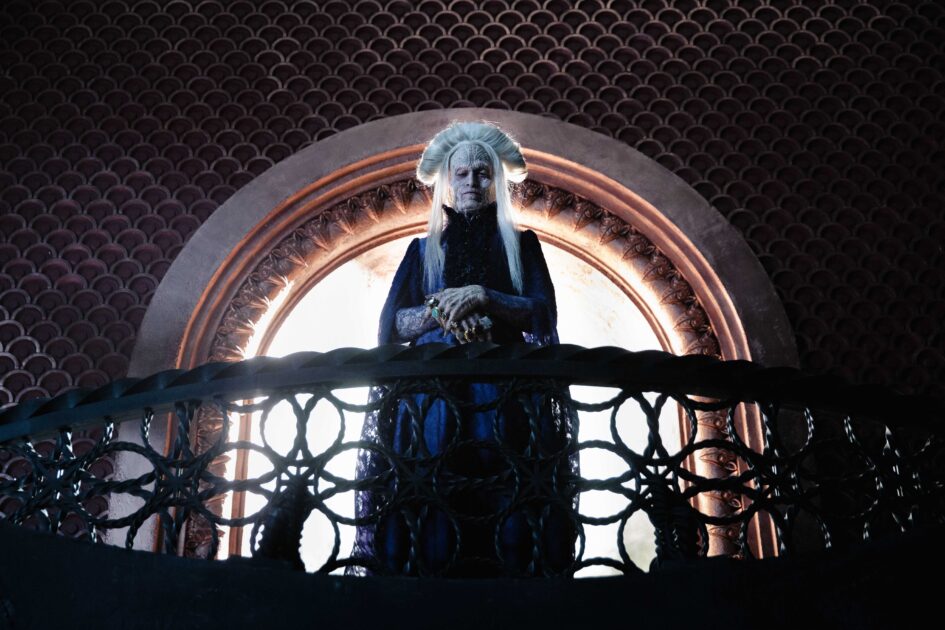
The beautiful costumes, the Gothic set design, the creepy, cool lighting and the stylistic cinematography all look incredible, award-winning, even. There’s no debating the film looks great. But for some reason, all of the film’s dialogue is in English, although taking place in multiple European and Asian countries. That seemed odd and out of place, much like Danny Elfman’s score, here, which feels more like background noise — something I’ve never said before, as he’s a favorite of mine — than an accent for the on-screen activity.
Jones provides a workman-like performance in his eternal search for true love, assisted by his now-living castle gargoyles, but he feels outshined by Christoph Waltz, who has a smaller role. Waltz must simply have the absolute best agent in the biz; he’s an actor who constantly reinvents himself with each role he accepts, even though his acting never seems to change. He’s that good.
And the eye-opener of the movie is definitely Matilda De Angelis, who simply steals every scene with her crazy-cute curls and her invigorating energy (as well as the constant fascination of her fangs) with every word spoken and whisking movement across the screen.
Full of individual great story elements, as a whole, Dracula (2025) stakes its reputation fully on Luc Besson’s name, who’s truthfully been on an extended hit-or-miss run ever since The Fifth Element — has it really been 28 years, already? Good, not great, this presentation is a mixed bag full of plot holes, but it should allow the filmmaker at least one more opportunity to bring another adventure to the big screen. Hopefully, one that’s solely brought to life by seasoned writer with plenty of screenplay experience.
“Life is nothing but a long, hard road. Death is a privilege that God grants you… and denies me.”