I have reached the age where regret no longer arrives in loud, cinematic moments. It shows up quietly. In the pause before sending a text that never gets written. In the memory of a conversation I rushed through because I assumed there would be more time later. Life has a cruel way of convincing you that unfinished sentences can always be revisited, right up until the moment they can’t.
There is a particular cruelty to loss when it leaves you with unfinished emotional business. Not anger. Not even guilt. Just the awareness that you were mid-sentence when the door closed. You replay the words you should have chosen, the tone you wish you had softened, the apology you convinced yourself could wait until tomorrow. Grief, in those moments, is less about missing someone and more about living with the echo of what you never got to say.
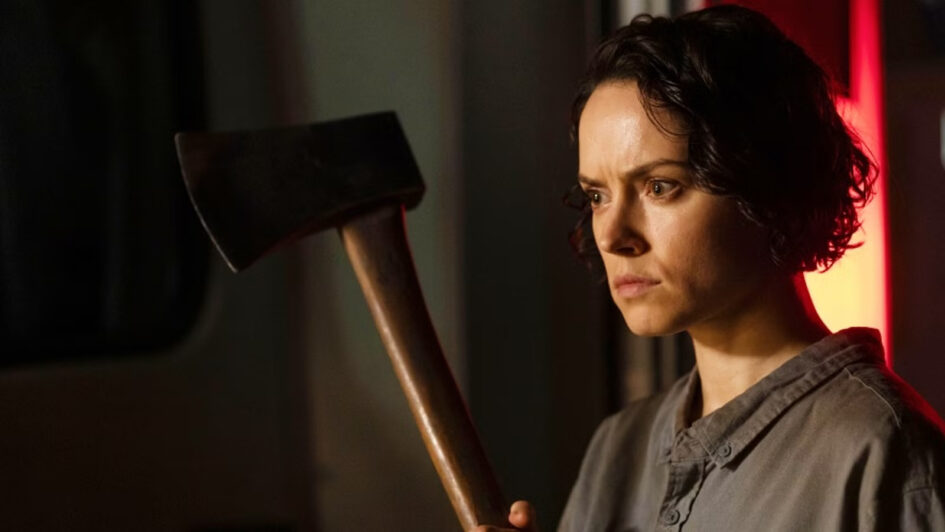
That feeling sits at the center of We Bury the Dead, a film built around the unbearable weight of things left unsaid. Daisy Ridley stars as Ava Neman, a woman searching for closure in the wake of a catastrophic military experiment in Tasmania, hoping for the chance to make amends with her husband, Mitch (Matt Whelan), who may or may not be among the dead. When the disaster zone is sealed off, Ava volunteers with a “body retrieval unit,” a grim assignment that offers no guarantees, only answers she may not be ready to hear.
She is paired with Clay (Brenton Thwaites), a man who moves through the wreckage with a disquieting calm, seemingly untouched by the scale of the carnage around them. As the recovery effort drags on and the dead refuse to stay that way, the job shifts from closure to survival.
What begins as a search for answers becomes a test of endurance, forcing two emotionally isolated people to rely on one another in a landscape that no longer recognizes the difference between the living and the lost.
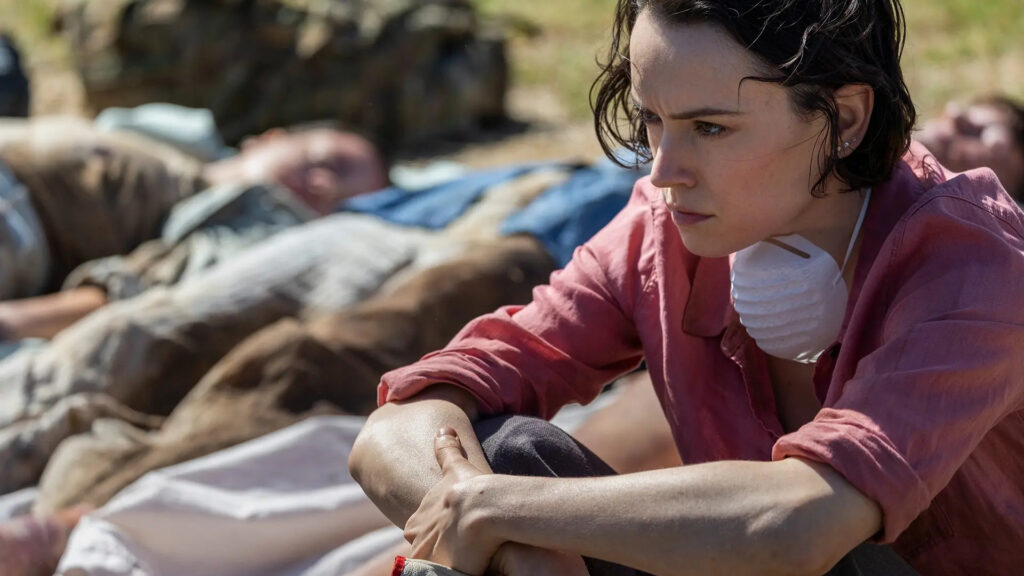
We Bury the Dead may initially appear to be a standard Zombie Apocalypse film, complete with quarantine zones and the lingering threat of the dead refusing to stay dead. But its true focus is not on spectacle or shock. The film is far more concerned with the emotional wreckage left behind, using the Apocalypse as a backdrop, rather than the main event. The undead exist here less as monsters and more as consequences, physical reminders of lives ended in an instant and relationships left unresolved.
By centering the story on grief and unfinished emotional business, the film shifts the genre’s usual priorities. Survival is not framed as a triumph, but as an obligation, and hope feels deliberately muted. We Bury the Dead asks what it means to keep going when closure may never come, finding its horror not in sudden violence, but in the quiet endurance of the people left behind.
Daisy Ridley turns in a quietly powerful performance, fully embodying the heartbreak of a woman burdened by words she may never get the chance to say. Her grief is restrained rather than theatrical, expressed in hesitation, exhaustion and the way Ava carries herself through a world that no longer offers closure. It is a performance built on emotional understatement, and it gives the film its most human anchor.
As for the horror, We Bury the Dead does not falter in that department. The undead initially appear less like monsters and more like broken people, frozen in place with vacant stares and slack bodies, as if something inside them has simply powered down. There is an unnerving intimacy to their stillness, like standing too close to a body that should not be breathing.
As the film goes on, that paralysis curdles into agitation, a shift the story takes time to justify rather than gloss over. The body horror lands, but it is the sound design that truly burrows under the skin. The guttural clicking they make, like teeth cracking, grinding and snapping inside a mouth that no longer cares about pain, is stomach-turning. It is a small detail, but one that makes every encounter feel wet, wrong and impossible to shake.
I give We Bury the Dead five out of five stars because it understands that the most devastating part of loss is not the moment someone is taken from you, but the silence that follows. The film uses the framework of a Zombie Apocalypse to explore something far more intimate: the burden of unfinished conversations and the quiet hope that maybe, somehow, there is still time to say what matters. Daisy Ridley’s performance anchors the story with restraint and sincerity, grounding the horror in emotional truth rather than spectacle.
By the time the credits roll, We Bury the Dead feels less like a genre exercise and more like a meditation on grief, obligation and the fragile belief that closure can still exist in a broken world. It lingers because it taps into a universal fear: that we all carry words meant for someone who will never hear them.
In tying its horror to that deeply human experience, the film earns its place among the most thoughtful and emotionally resonant entries in the genre.