
In 1995, I was 17 years old and working at a video store. While most people remember Toy Story for introducing them to Woody and Buzz, what I remember most is the feeling that I was watching the future where tech was going to be king. Computer animation was still a novelty, and nobody knew that a movie about a cowboy and a space ranger would become one of the most beloved franchises in cinema history.
It intrigued my nerd half enough to actually look into going to college to learn computer animation.
Fast forward to today, and I have a daughter of my own who is every bit as fascinated by technology as I was. The difference is that my curiosity came from wondering what computers might someday become. Her generation already has those answers, sitting in their hands. Tablets, gaming systems and endless entertainment are just a normal part of life.
That generational shift sits at the heart of Toy Story 5, which asks what happens when toys find themselves competing with technology for a child’s attention.
In Toy Story 5, Bonnie (Scarlett Spears) is still spending her days with Buzz Lightyear (Tim Allen), Jessie (Joan Cusack) and the rest of her beloved toys. Concerned that she is struggling to make friends, Bonnie’s parents introduce her to a new tablet called Lilypad (Greta Lee). As the device quickly becomes the center of Bonnie’s attention, the toys begin to wonder if they still have a place in her life.
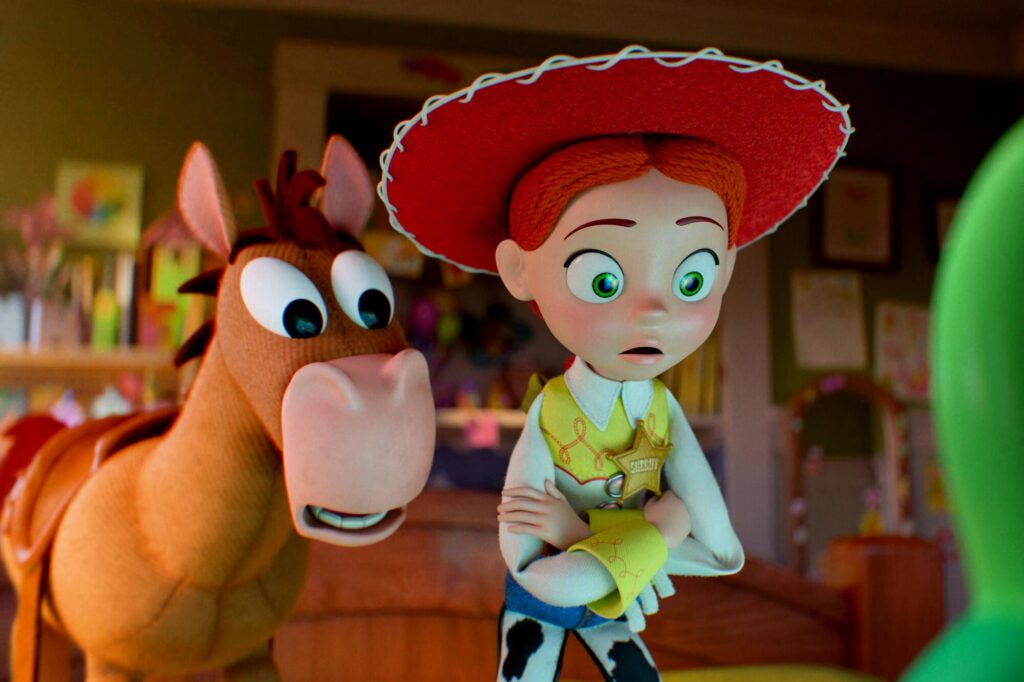
For Jessie, the change is especially painful. Having already experienced being left behind by a previous owner, she turns to Woody (Tom Hanks) for guidance. But Lilypad has no intention of stepping aside, believing she can help Bonnie navigate the challenges of childhood better than any toy ever could.
As tensions rise and a series of misadventures unfold, Woody, Buzz and Jessie find themselves fighting to protect the bond they share with Bonnie before it slips away forever.
That premise resonated with me more than I expected. If I let my daughter, she would happily spend every waking moment glued to a tablet. To be fair, it is locked down pretty tightly with age-appropriate games, videos and educational content. Even so, I often find myself encouraging her to put the screen down and do something else.
Sometimes that means arts and crafts spread across the kitchen table. Other times it means getting out of the house for an adventure, whether that’s a trip to a convention, a movie theater or just somewhere new to explore.
The challenge is that technology is designed to keep our attention. Convincing a child to step away from an endless stream of entertainment can feel like an uphill battle. That’s what makes Toy Story 5 surprisingly relevant. Beneath the jokes and colorful characters is a conversation many parents are already having about finding balance.
Technology isn’t the enemy, but it shouldn’t be the only thing competing for a child’s imagination. The film understands that struggle and uses it as the foundation for its story.
What impressed me most is how naturally the story handles that theme. It would have been easy for Pixar to turn Lilypad into a villain and make the film a lecture about kids spending too much time on screens. Instead, the script takes a much more thoughtful approach. The conflict isn’t really about technology vs. toys. It’s about connection and belonging and the fear of becoming irrelevant.
Those are themes that have been woven into the franchise since the beginning, and Toy Story 5 finds a fresh way to explore them without feeling repetitive. The result is a story that works on multiple levels. Younger viewers will enjoy the adventure and humor, while parents may find themselves reflecting on how childhood has changed since Woody and Buzz first arrived on the big screen more than 30 years ago.
I also appreciated how much attention the film gives to Jessie. Ever since Toy Story 2, she has been one of the franchise’s most tragic characters. We learned about the heartbreak of being abandoned by her original owner and the emotional scars that experience left behind. While that backstory has always been part of who Jessie is, Toy Story 5 finally puts it front and center.
The possibility of losing Bonnie forces her to confront those old fears all over again.
What makes the character work so well is that her concerns feel completely justified. Woody, Buzz and the other toys worry about being replaced, but Jessie has already lived through that pain once before. She knows exactly what it feels like to be forgotten. The film uses that history to add real emotional weight to the story, transforming Jessie from a supporting character into the emotional heart of the movie. By the end, she feels more fully developed than ever before, and her journey is easily one of the strongest aspects of the film.
If I have one major criticism, it is that the franchise is beginning to show its age. Pixar continues to find new angles and meaningful themes to explore, but there are moments where Toy Story 5 feels like a series searching for reasons to continue. The emotional farewell in Toy Story 3 felt like a natural ending, and even Toy Story 4 managed to provide Woody with a satisfying conclusion.
By the time a fifth film arrives, there is an unavoidable sense that most of these characters have already completed their journeys several times over. That doesn’t mean Toy Story 5 is unnecessary.
In fact, it tells one of the stronger stories in the franchise’s later years. But there are moments when I couldn’t help but wonder how many more adventures Woody, Buzz and the gang have left in them before the series starts repeating itself. The film succeeds because it has something meaningful to say about childhood and technology, not simply because it reunites familiar characters. As strong as this entry is, Pixar may want to start thinking about where the finish line for this beloved franchise truly lies.
I give Toy Story 5 five out of five stars.
What began as a groundbreaking experiment in computer animation has evolved into one of cinema’s most consistently heartfelt franchises. More than 30 years after I first watched Woody and Buzz on the big screen, Pixar has once again found a way to tell a story that feels both timely and timeless. By exploring the challenges of growing up in a technology-driven world while giving Jessie one of her strongest character arcs to date, Toy Story 5 proves there is still some life left in this toy box.
Perhaps what surprised me most is how much the film connected with me as a parent. As I watched Bonnie struggle to balance her toys and technology, I couldn’t help but think about my own daughter and the ongoing negotiations over screen time that seem to be part of modern parenting.
Sitting in a theater on Father’s Day, watching a movie about toys trying to pull a child away from a tablet, felt a little too relatable at times. Thankfully, unlike Woody and Buzz, I have one advantage they don’t: I know the Wi-Fi password.