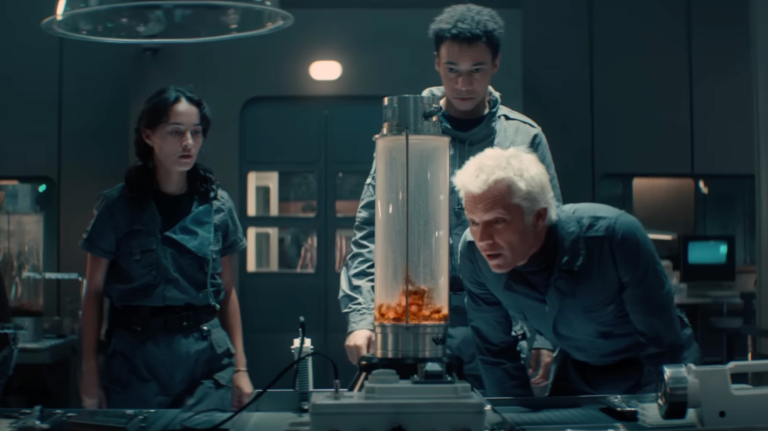
Nothing good seems to ever happen for Weyland-Yutani deep-space research vessels searching for specimens… sound familiar? It should. It was the basis of Ridley Scott’s blockbuster feature film from 1979, as it is for this streaming series of 2025. Well, welcome to the premise of the spin-off, Alien: Earth.
I’m really not a fan of retcons. I do love me some science fiction… and I really love me some sci-fi horror. It’s no wonder I truly embraced the big-screen visions of Ridley Scott and James Cameron. But I really do hate retcons (Did I mention that, already?). They often present too many modern-day elements to simplistic stories of the past. But I truly enjoy the Alien franchise… for the most part.
Can’t you see the conflicting emotions I’m experiencing?
I’ve been hesitant to welcome too much change to these films within the 21st century of moviemaking. Sure, too much of the same thing eventually gets stale, but too much of a dramatic shift away from what made these three individual movies (I’m even including Alien 3 among the instant classics of Alien and Aliens) so great upon their release, and my fandom searches elsewhere for claustrophobically gripping tales of galactic sci-fi horrors.
Set during the year of 2120 — and taking place two years before the events of the 1979 original release — apparently, the main theme of Alien: Earth is based upon a brief intro screen, which lists, “In the future, the race for immortality will come in three guises, cybernetically enhanced humans: cyborgs. Artificially intelligent beings: synths. And synthetic beings downloaded with human consciousness: Hybrids.”
In this setting, five companies govern the entire globe (read: control the planet) and Boy Kavalier (played by Samuel Blenkin with a fresh exuberance in the face of disaster), has become the youngest trillionaire, ever. He’s found a way to approach immortality via Prodigy Corporation, where sickly children threatened with looming death sentences are transitioned into new “forever bodies.”
There’s a Peter Pan-like element to this story, as Marcy accepts her new body with the name of Wendy (played by Sydney Chandler), becoming the first human transitioned into an artificial body, later followed by other children. She plays the role of older sister to them, even though they’re roughly the same age.
That part of the story doesn’t interest me very much, but events really get started when the spaceship USCSS Maginot presumably runs out of fuel, crash landing into an occupied city and a subsequent high rise that feels larger than 9/11 — although the subsequent small-screen destruction feels marginal (although there is plenty of chaos and ash floating in the air).
After Wendy discovers her brother, Prodigy Medic Hermit (Alex Lawther), happens to be at the crash site searching for survivors and unaware of her transition, she quickly volunteers to lead these kids-turned-beings into becoming prototypes-turned-first responders to help the spaceship’s survivors.

The search-and-rescue of the survivors brings back a familiar claustrophobia, as both the wrecked ship and the crumbling building deteriorate. But when the characters discover that previous scientific experiments have escaped the controlled atmosphere of the ship, the chaos brings a new adventure to the Xenomorphs (among other space creatures).
One of the biggest reasons I’m no fan of retcons (or retroactive continuities, for those unfamiliar with the term), is the introduction of new elements to older storylines, which were never originally there, ultimately creating a thematic paradox, of sorts. The oversized series premiere, “Neverland,” introduces multiple new species of creatures that have never before been seen on screen, including Blood Bugs, The Eye Octopus, The Flower Bud and the Flying Bug, without any mention of what they are. For a while, I even thought these blood-sucking bugs were never-before-shown early stages of Facehuggers, but eventually I figured out that wasn’t the case.
Introducing new story elements to older releases doesn’t simply layer previous movies, demanding rewatches, but they force the viewer into a disbelief that other forces are present, when they were never originally there. I guess that’s one reason why filmmaker Ridley Scott was brought onto the series as a producer (out of 24, in total!).
So, what seems to be a riff on Prometheus in uncovering humanity’s origins and its collective place within the universe, this TV series seems to be a sci-fi exploration in how artificial intelligence shapes the world (and eventually, other worlds), with a side of Xenomorphs, instead of simply being a great sci-fi horror side story found within a great film franchise. Feels like it’s trying extra hard to be what Andor did for Star Wars.
I’m not so sure I’m glad that Sir Scott is involved with this production… or Noah Hawley, for that matter. Why couldn’t James Cameron have been approached, instead? While Hawley loves to tackle such heady topics (see: Legion) and then lose interest after one season with deteriorating results (also read: Legion), I’ve got a steady wait-and-see approach for this limited series (there’s only eight episodes in Season 1!).
While I love the retro futuristic spaceship, I don’t love all its sensibilities (Smoking in a spaceship doesn’t even make sense!), even though it was previously presented in the 1979 original. The all-knowing father figure of Timothy Olyphant’s Kirsh subtly steals every scene while trying to appear an artificial intelligence and elements of Robocop remain throughout, as flashback memories of once being human haunt our main character.
The pilot mostly questions moral judgements, while Episode 2, “Mr. October,” reunites the long-lost siblings, highlighting the isolation horror with some psychological terrors. Accepting the good and the bad, I enjoyed the original four Alien films, quirks and all, but I eventually lost interest in the franchise with each subsequent sequel. I guess I’m not too keen on exploring artificial intelligence, but I am interested in how these futuristic companies first discovered the Xenomorph species, rather than replaying the events of the much better storylines of the first two movies in the franchise.
I suppose it’s possible that Earth already had a Xenomorph problem before Ripley fought them tooth and nail in outer space, but this introduction of a killer, invasive species, unleashed upon an unknown population, doesn’t feel like a life-or-death scenario… yet. It’s possible those stakes are eventually raised, and our naive, innocently scared adolescent protagonists (housed within adult bodies) fighting cut-throat corporate antagonists (along with mother nature) will save the day. And if not, there’s always the possibility to retcon Cameron’s sequel into making this series make sense.
It may be a little premature to begin my #MakeAlienGreatAgain campaign, but I’m already making campaign promises…