The first time I played mini golf, I won so easily that I figured the spirits of Arnold Palmer and Bobby Jones had taken possession of my body. Apparently, both men had been waiting for the chance to bank a shot off a windmill. Then I tried “real” golf and discovered I was channeling a much different spirit: a drunk lumberjack who had never seen a golf ball before. I spent more time looking for my shots than taking them. I didn’t even make it past the second hole before I was tired, defeated and ready for hot wings.
Whatever I was channeling, I’m pretty sure the geologists in Split Rock have it worse.
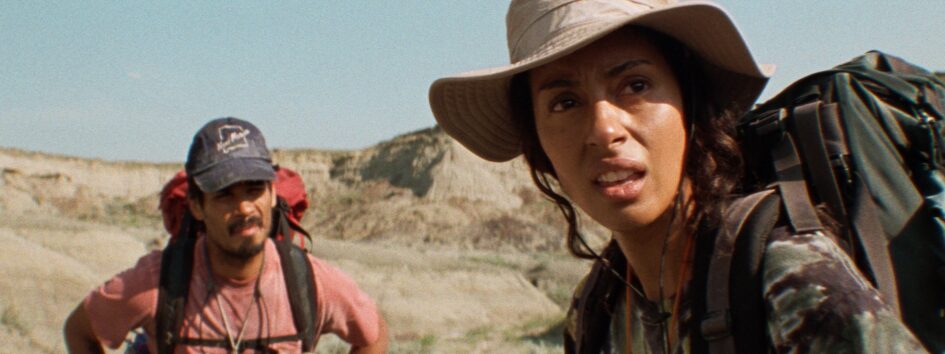
Written and directed by Ryan Glover, Split Rock follows geologists/lovers Lauren (Clark Backo) and Ben (Drew Ray Tanner) as they conduct survey work in the remote Canadian badlands alongside their colleague Sam (Olivia Luccardi) and intern Trevor (Graham Verchere).
When the group uncovers a mysterious block of magnetic stone embedded in the earth, what begins as a discovery worth investigating becomes increasingly unsettling. Their equipment starts to fail, leaving them struggling to understand the anomaly in an isolated landscape.
As a violent, unseen force emerges, the danger extends beyond malfunctioning instruments. Lauren becomes convinced that an ancient consciousness buried beneath the earth is using her mind to reach the surface.
With their scientific understanding offering few answers, the group must confront something they may have disturbed without knowing what it is or what it wants.
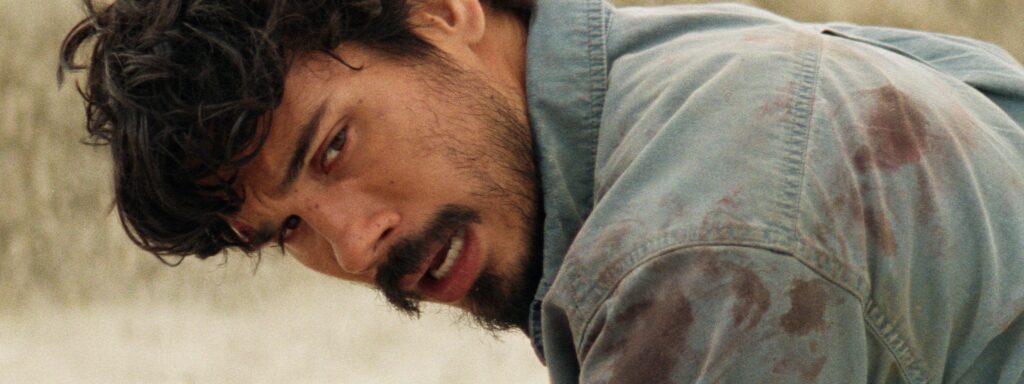
Split Rock was shot on Kodak Super 16 mm film, but what does that actually mean for those of us who don’t spend much time behind a movie camera? Cinematographer Nikolay Michaylov recorded the images on physical film instead of a digital sensor. The “16 mm” refers to the width of the film strip, and “Super” means more of that strip is used to capture a wider image.
Film has natural grain, a fine texture that is generally more noticeable in this smaller format. It gives filmmakers a particular look to work with, rather than automatically making a movie look better.
The film also uses an unusually wide 2.66:1 frame, meaning the picture is more than twice as wide as it is tall, giving its badlands setting plenty of space across the screen. That shape comes from how the movie was photographed, rather than from Super 16 alone. Its upcoming festival screenings will use 35 mm prints, which might sound confusing, but the distinction is simple: 16 mm was used to capture the movie, and 35 mm will be used to project it.
That wide frame really pays off in the way Split Rock captures the badlands.
One shot that stood out to me has Lauren and Ben sitting and talking at dusk. They’re in the foreground, close enough that I would expect them to dominate the image, yet the landscape stretches so far behind them that they seem tiny within it. Their proportions still look natural. It’s the sheer scale of their surroundings that makes the difference. I could follow their conversation while taking in just how much open space surrounded them, and that pulled me into the movie.
While the cinematography pulled me into the badlands, the performances didn’t make quite the same impression.
The cast does a decent job, but no one particularly stood out to me. The script follows a familiar path, making Split Rock feel like a fairly standard supernatural-possession film. Its predictability didn’t detract much from my enjoyment, though I found myself more impressed by how the story was filmed than by where it was going.
That said, I had a major issue with the sound. Once the supernatural entity is unleashed, an incredibly high-pitched noise starts playing, and it lasts far longer than I could comfortably tolerate. I kept waiting for it to stop, eventually turning down the volume on my iPad while watching the screener. Then it returned several more times throughout the film.
I don’t have tinnitus, but this was close to what I imagine it might feel like. The noise made my head hurt and left me a little nauseated, pulling me out of a movie whose visuals had done such a good job drawing me in.
I give Split Rock three out of five stars.
The cinematography is fantastic and worthy of awards, making the badlands feel vast in a way that pulled me right into the movie. Unfortunately, the bland, predictable story, unmemorable performances and that nauseating sound kept me from rating it any higher. There’s plenty worth looking at here, but my ears were ready to call it quits.
Much like my brief attempt at real golf, I reached a point where I just wanted some hot wings.