
There’s something about living with a dog that can be both comforting and unnerving. My black lab, Luna, has been my faithful companion for years, and she’s usually the picture of calm. But every so often, she’ll do something that sends a chill up my spine. She’ll lift her head mid-nap and stare at a corner of the room like something, or someone is there that I can’t see. Her ears perk, her body stiffens, and she tracks invisible movement as if she’s following a ghost across the wall.
I’ll sit there watching her, heart thudding, wondering: does she see things I can’t? Is Luna like that little boy from The Sixth Sense, quietly tuned into a world I’m oblivious to?
Of course, there’s also the chance Luna just sees me get up too many times for late-night snacks and thinks the shadows are plotting against us. Maybe she’s not some supernatural sentinel at all. Maybe she’s just judging me for not turning on a single light switch in the house. Either way, if she ever starts whispering, “I see dead people,” I’m out the door before she can finish the sentence.
It’s that same feeling of unseen presences that Good Boy leans into, making you question what your own furry best friend might be hiding behind those puppy dog eyes.
Good Boy (2025) marks the directorial debut of Ben Leonberg, and it takes an unconventional approach to horror by placing the story through the eyes of a dog. The film follows Indy, a Nova Scotia Duck Tolling Retriever, whose owner, Todd (Shane Jensen), retreats with him to an isolated family estate after being stricken with what seems to be a terminal illness.
As Todd wastes away in seclusion, Indy becomes the unlikely witness to a series of unsettling events that haunt the property: disturbances that only he seems able to see.
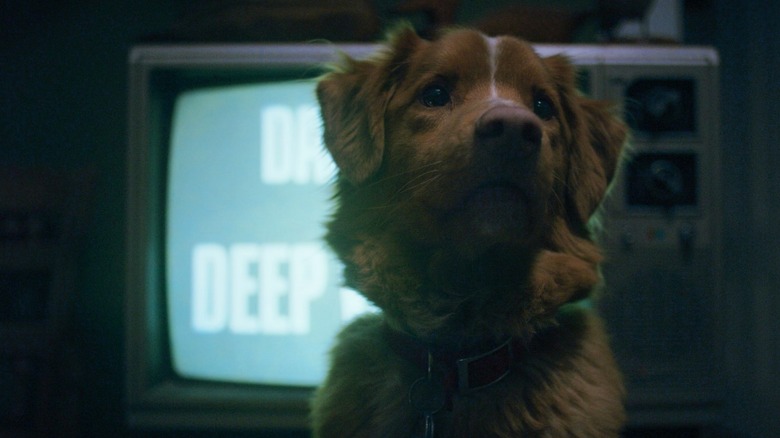
As most horror fans already know from the buzz surrounding Good Boy, the film’s big hook is that the entire story is presented from the dog’s point of view. On paper this sounds like a bold and refreshing idea that could bring something new to the genre. Experiencing the action through Indy’s eyes has the potential to make the scares feel raw and immediate. Unfortunately the execution does not live up to the promise. What begins as a clever gimmick quickly turns into an annoyance.
The constant POV shots may be interesting at first, but before long they wear thin, taking attention away from the tension and leaving the audience more aware of the camera work than the story unfolding.
Although the perspective loses its novelty rather quickly, Good Boy does manage to deliver moments that most other horror films cannot replicate. Because we are locked into Indy’s viewpoint, we only ever get fragments of the larger story. When Todd is warned about the strange occurrences in the house or receives an update about his deteriorating health, we as the audience, are not given the full picture. Instead, we arrive in the middle of conversations alongside Indy, hear just enough to form a partial understanding, and then watch as he wanders away the moment something else catches his attention.
Sometimes he leaves just as the most important information is being revealed. This approach cleverly mirrors a dog’s natural focus and short attention span, and in doing so, it adds an intriguing layer of tension. The audience is forced to piece together the narrative with only hints and scraps, which keeps the mystery alive and ensures that we are never entirely certain of what is happening behind the scenes.
Even with a runtime of only 73 minutes, Good Boy feels like it drags on far longer than it should. Not long ago I reviewed another film that used a similar gimmick, Blondi, which screened at the 2025 Nashville Film Festival. Both projects told their stories entirely from the perspective of a dog, but the difference in format made all the difference in execution. Blondi was a short film, running just under 20 minutes, and its brevity allowed the concept to shine. It was tight, focused and ended on a dramatic note before the dog’s-eye perspective wore out its welcome.
Good Boy, on the other hand, stretches the idea into feature length, and much of that time is spent building toward its final horrific reveals. The result is a slow and often tedious experience. With a leaner runtime and sharper pacing, this film could have been more effective, perhaps even spectacular.
Good Boy receives three out of five stars. While the concept of seeing a horror story unfold entirely from a dog’s perspective is intriguing, the execution struggles to sustain interest over a full feature runtime. There are clever moments where the limited viewpoint adds mystery and tension, but the novelty wears thin quickly, leaving stretches of the film that feel repetitive rather than suspenseful. Still, it is a unique experiment that horror fans may appreciate for its ambition, even if it does not quite stick the landing.
Watching it made me think about Luna once again. Every time she perks her ears or stares at something invisible to me, I cannot help but wonder what she really sees. Maybe it is just the shadows playing tricks, or maybe she knows more than I ever will. If Good Boy proves anything, it is that sometimes our dogs are watching more than we realize — and maybe, just maybe, that is the scariest thought of all.