I grew up around faith the way some people grow up around fire. It was always present, always framed as protective and always capable of doing real damage, depending on who was holding the match. I watched ordinary people gain unquestioned authority the moment they stood behind a pulpit or spoke with divine certainty. No weapons, no threats. Just belief, obedience and the quiet understanding that doubt, itself, was treated as a moral failure.
That kind of power has always frightened me more than any weapon of mass destruction, which is what makes Wake Up Dead Man, the third film in Rian Johnson’s Knives Out series, such an intriguing entry. Beneath its familiar murder-mystery structure, the film grapples with how belief becomes authority and how authority goes unchallenged. The question at the heart of the mystery isn’t just who committed the crime, but who was allowed to, and why no one thought to stop them.
Wake Up Dead Man brings our favorite detective Benoit Blanc (Daniel Craig) back into the spotlight for another murder mystery, this time set within the unsettling confines of a tightly knit religious community. When Monsignor Jefferson Wicks (Josh Brolin) is murdered in front of his congregation during a Good Friday service, suspicion immediately falls on Jud Duplenticy (Josh O’Connor), a young priest recently assigned to the parish whose tense and openly hostile relationship with the monsignor made him an easy target.
As Blanc digs deeper, he uncovers a congregation rotting from the inside out, one built on secrets, influence and quiet corruption. The list of suspects quickly grows to include Martha (Glenn Close), Dr. Nat (Jeremy Renner), Vera (Kerry Washington), Lee (Andrew Scott), Simone (Cailee Spaeny), Samson (Thomas Haden Church) and Cy (Daryl McCormack).
With every revelation pulling another thread loose, the question becomes less about if someone had motive and more about which truth finally forces its way into the light, and why the killer believed they would never be questioned at all.
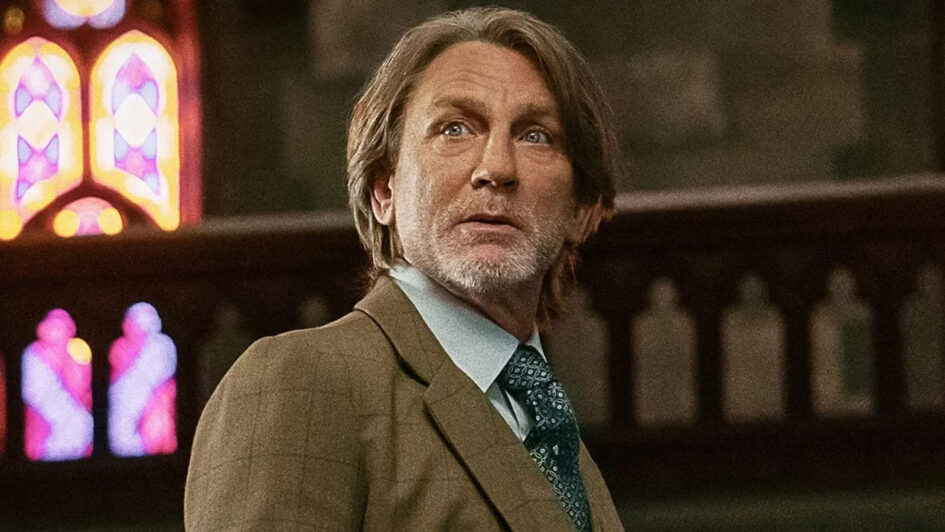
One of Wake Up Dead Man’s greatest strengths is how confidently it establishes its own visual identity within the Knives Out series. Rian Johnson leans hard into atmosphere this time, using shadow, candlelight and carefully composed frames to turn the church setting into something that feels both comforting and oppressive.
The film constantly places characters in pools of light surrounded by darkness, visually reinforcing the idea that public righteousness and private corruption rarely occupy the same space. It gives the mystery a heavier, almost gothic tone that perfectly suits a story about belief, power and the dangers of unquestioned authority.
That confidence extends to the structure of the mystery, itself. Benoit Blanc remains endlessly watchable, but this film smartly allows the ensemble to carry more thematic weight than spectacle. Each suspect feels fully realized, not just as a potential killer but as someone shaped by the system they exist within. The script trusts the audience to sit with uncomfortable ideas about morality and complicity without rushing to easy answers, and when the final pieces fall into place, the resolution lands in a satisfying, not showy, manner.
It is a reminder that the Knives Out films work best when the puzzle serves the theme, not the other way around.
The performances are where Wake Up Dead Man truly locks into place, with Daniel Craig and Josh Brolin delivering the film’s most commanding work. Craig continues to refine Benoit Blanc into something sharper and more deliberate, playing him less like a flamboyant detective and more like a man patiently waiting for people to expose themselves. There is a quiet authority to his performance this time, a sense that Blanc understands the moral stakes of the case as much as the mechanics of the mystery.
Craig’s restraint gives the character a gravity that pulls every scene toward him without ever demanding attention.
Josh Brolin leaves a lasting impression, despite the limited screen time that comes with playing the victim. He embodies authority, entitlement and moral superiority with chilling ease, making it instantly clear why his influence continues to loom over the congregation long after his death. Every scene he appears in reinforces how deeply he shaped the people around him, and Brolin fully embraces the role of a man who weaponizes his position at every opportunity.
The rest of the ensemble smartly fills in the space he leaves behind, with each performance adding texture and tension to the community at the center of the mystery. Each character feels shaped by the same system of control and compromise, creating a congregation that feels fully realized rather than conveniently assembled. No one fades into the background, and the collective strength of the cast ensures the mystery is driven by believable people instead of interchangeable suspects.
The film’s ambition occasionally works against it, particularly in how crowded the mystery becomes. With so many suspects, motivations and overlapping secrets, Wake Up Dead Man sometimes loses the tight precision that made earlier entries in the series feel so cleanly constructed. While the sprawl adds texture and reinforces the idea of collective complicity within the congregation, it also softens the impact of certain revelations and makes the mystery feel more tangled than finely tuned.
The result is a story rich in ideas and atmosphere, but one that is not always as tightly wound as its premise demands.
I give Wake Up Dead Man five out of five stars. Despite its occasional narrative sprawl, the film succeeds because it has a clear understanding of the ideas that it is actually presenting. This is not a story about a single act of violence, but about the systems that allow harm to hide behind authority, tradition and unquestioned belief. By the time Benoit Blanc brings the truth into the light, the mystery has shifted from simply identifying a killer to exposing a structure built on silence and obedience. That thematic core ties directly back to the weaponized faith at the heart of the story, giving the film a sense of purpose rather than excess.
For a series that could have easily settled into formula, Wake Up Dead Man instead aims higher, pushes a little darker and still knows exactly when to let the humor cut through the tension. And if nothing else, Wake Up Dead Man serves as a helpful reminder that some of the most dangerous rooms in the world are not the ones filled with weapons, but the ones where everyone nods along and says, “Amen.”
Jason Kittrell
Jason Kittrell is a member of the Music City Film Critics Association and he's also active within the horror community.