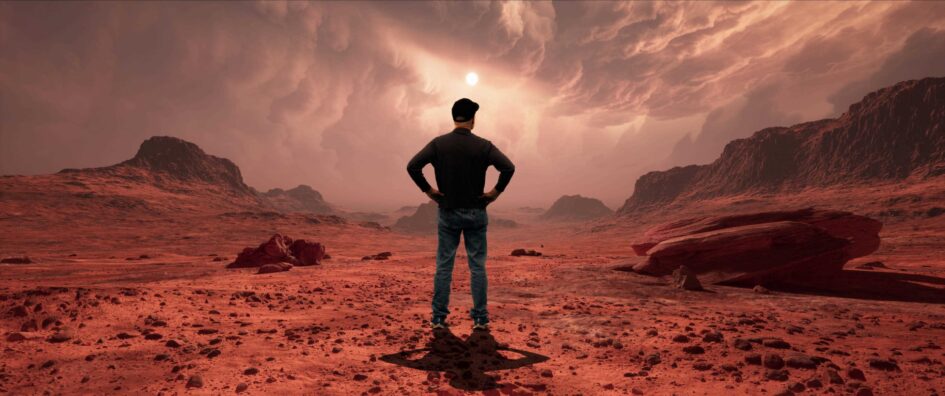
I tend to lean heavily toward the science fact portion of science-fiction stories. A good space opera will definitely grab my attention, but it’s the real-world mechanics that really pique my interest on the big screen. Will humanity ever have a working warp drive? What about time travel? And don’t get me started on how we will ultimately prevent a highly advanced, self-aware artificial intelligence with a death wish for humanity.
Where, exactly, is this cold intro leading? It might be a little scatterbrained, but with an eye to the sky and his head in the clouds, it’s also symbolic for Gentry Lee, the Starman.
Representing a variety of quantitative data throughout his almost 60 years while being employed at NASA, from working on multiple Viking space projects, to being the chief engineer for the Galileo mission, to having oversight responsibilities for the Mars Exploration Rovers, Lee’s first lifelong fascination wasn’t actually found outside of planet Earth. It was his pure love of the game.
At 5 years old, Lee began calculating his favorite Major League Baseball players’ batting averages, which introduced the youngster to numbers, eventually leading him to getting his master’s degree in physics, mathematics and aerospace engineering at MIT. Inspired by JFK with a scientific quest for knowledge, Lee became part of the first generation to explore the solar system.
Currently working as the Chief Engineer for the Solar System Exploration directorate at the Jet Propulsion Laboratory (JPL) in Pasadena, California, Lee didn’t limit his exploration of outer space to the property of NASA, collaborating with Carl Sagan to create the monumental TV show, Cosmos, and later co-writing a series of sci-fi novels with his hero, author Arthur C. Clarke. At the age of 82, he currently oversees 18 to 20 projects in various stages of development for the government agency and Lee has no plans to slow down anytime soon.
“No good scientist, engineer or futurist ever makes a categorical statement that something is impossible.”

Written, directed, produced and edited by Robert Stone, this is no boring museum movie. Effort is carefully displayed to detail Lee’s many individual achievements and collaborations with science-fiction luminaries. His personality is infectious, as is his need for cosmic intelligence. It’s movies like Starman — no relation to the 1984 Jeff Bridges release of the same name — Hidden Figures and The Martian that always awaken the can-do spirit of human nature for me, in terms of overcoming daunting obstacles.
As an engineer who has overseen the building of robotic spacecrafts, a science-fiction writer and a futurist, I was hoping Lee would expound upon his personal beliefs that the truth is out there, somewhere. Alas, that was not meant to be for this project, but his closest reference is, “If we discover life of any kind, anywhere other than on the planet Earth, it will be the greatest scientific discovery in history.”
**sigh**
I was literally hanging onto every word he speaks up until the final 10 minutes of the film, when climate change is introduced. I mentally checked out as he scolds Elon Musk for placing such a high priority of the human race to colonize Mars as he unnecessarily gets political.
Touching on a wide variety of subjects within a limited amount of time, Starman is a little scatterbrained, never quite focusing on one topic. Incredibly inspirational at times and frustratingly oblivious at others, the runtime of an hour and 25 minutes is an uneven rollercoaster of reactionary emotions. I was just expecting a little more from the award-winning filmmaker, Robert Stone.
In terms of introducing the world to Chief Engineer for Planetary Exploration Gentry Lee, Starman does a decent job. But in terms of tight storytelling with a central focus, this film leaves viewers lost in space.
“The greatest value of science fiction is the way it opens your mind to possibilities…”