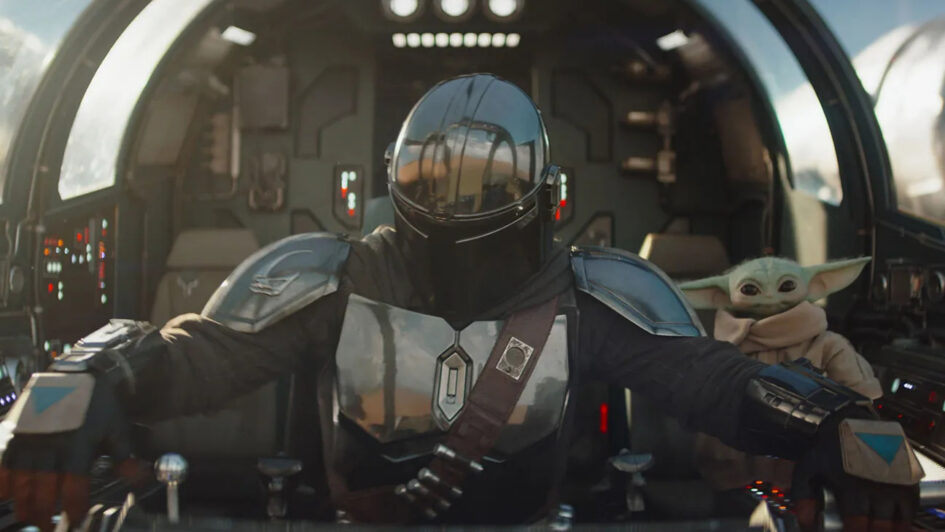
I remember when Grogu first showed up in The Mandalorian and my immediate reaction was basically, “Oh look, here comes Disney’s newest marketing scheme.”
It felt obvious to me, at the time. You’ve got this tiny green baby alien with big eyes, like a puppy. Instantly there were plushies, life-size toys and t-shirts emblazoned with “The Child” on them. It was the kind of character designed in a boardroom to sell backpacks, coffee mugs and probably McDonald’s happy meals.
And honestly? I rolled my eyes a little at the thought.
Then somehow, against my better judgment, I got attached to the little chaos goblin.
Maybe it was the way he waddles around the galaxy pressing buttons he absolutely should not press. Maybe it was watching this hardened bounty hunter slowly turn into the galaxy’s most exhausted space dad and feeling that connection. Or maybe it was because Grogu acts exactly like every toddler who ever walked (or crawled) on God’s green Earth… if that toddler also had the ability to use The Force and casually steal someone’s lunch in the middle of a firefight.
Whatever the reason, somewhere along the way, I stopped seeing Grogu as a marketing gimmick and started seeing him as the emotional core of the modern Star Wars, which is wild, considering half the time he is either committing minor crimes, eating random creatures whole or making Din Djarin question every life decision that led him to this point.
Last weekend I took my daughter and fiancée to see Star Wars: The Mandalorian and Grogu, the latest chapter in the ever-expanding Star Wars Universe. Directed and co-written by Jon Favreau, the film picks up after the events of The Mandalorian series and follows Din Djarin (Pedro Pascal) and Grogu as they take on a new mission for the New Republic.
Their assignment is to track down Commander Coin, a former Imperial officer now leading a dangerous warband somewhere in the Outer Rim.
The problem is nobody seems to know where Coin is hiding, or even what he currently looks like. In an effort to get information, Commander Ward (Sigourney Weaver) brokers a deal with the Hutt Twins. In exchange for intelligence on Coin’s whereabouts, Din agrees to rescue Rotta the Hutt (Jeremy Allen White), the son of Jabba, and return him safely to Nal Hutta.
Things quickly become more complicated when Din and Grogu discover that Rotta is not exactly being held prisoner. Instead, he has embraced life as a gladiatorial fighter, working for a ruthless salt trader named Janu (Jonny Coyne). With few options left, Din must somehow convince Rotta to abandon the life he has chosen and return home.
Of course, this being Star Wars, there are larger schemes unfolding behind the scenes, and the true intentions of the Hutt Twins may be far more dangerous than anyone realizes.
One of the things I appreciated most about The Mandalorian and Grogu was how easy the story was to follow. Modern franchise films sometimes feel like you need an Excel spreadsheet and six seasons of homework just to understand what is happening, but this movie does a solid job of keeping things accessible. Even though it continues the story from The Mandalorian, it quickly gets viewers up to speed without drowning them in exposition.
My daughter has only seen small pieces of the show, yet after the short opening text she had no problem understanding the plot, the characters or what the mission was. That says a lot about how well the screenplay is structured. At its core, this is a simple adventure story about Din and Grogu trying to complete a mission that slowly becomes more complicated, and the film keeps its focus there instead of getting buried under Star Wars lore and continuity overload.
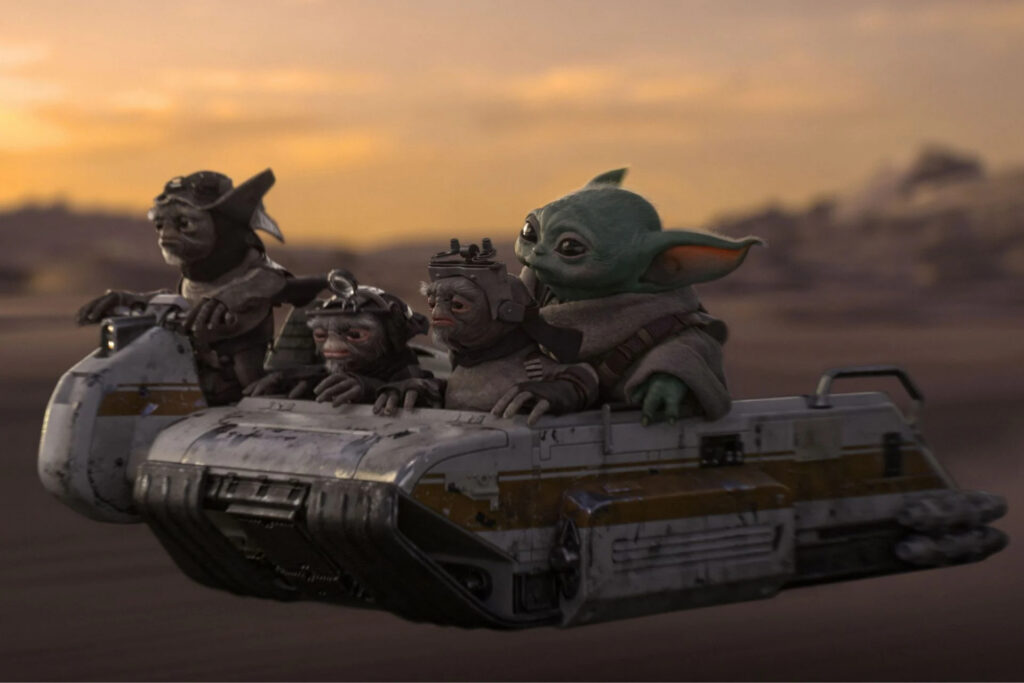
Of course, a huge part of the charm of The Mandalorian and Grogu comes from the incredible practical effects work used to bring Grogu and the four Anzellans to life. I really appreciated that the majority of their scenes rely on physical puppets operated by an obviously talented crew of puppeteers instead of turning everything into a CGI cartoon.
The movie still uses digital effects when it makes sense, especially during some of the larger action scenes, but it never feels overly dependent on them.
You can absolutely tell at times when Grogu or the Anzellans are moving like puppets, and that is part of the appeal for me. There is a certain charm and personality that practical creatures bring to the screen that pure CGI still struggles to replicate.
For those of us who grew up loving the practical effects of the original Star Wars trilogy, it adds a strong sense of nostalgia and makes the galaxy feel more tangible and lived in.
On the negative side, The Mandalorian and Grogu does start to drag a bit in the middle section. As much as I appreciated the straightforward and easy-to-follow story, there are moments where the movie feels like it is adding extra twists and detours simply to stretch out the runtime.
One of the major plotlines introduced early on actually wraps up much faster than I expected, and the resolution feels surprisingly anticlimactic, considering how much buildup the film gives it.
Because that storyline concludes relatively early, the movie spends part of its middle section trying to refill that narrative momentum with additional complications that do not always feel necessary. It never completely loses me, mostly because Din and Grogu remain entertaining enough to carry weaker scenes, but there were definitely stretches where it felt like the film was searching for a second gear after resolving one of its stronger hooks too soon.
I give The Mandalorian and Grogu four out of five stars.
Even with some pacing issues in the middle and a storyline that wraps up a little too quickly, the film still captures something Star Wars has occasionally struggled with lately: fun. It feels like a genuine space adventure again, packed with exciting action, strong practical effects and plenty of heart between Din and Grogu.
More importantly, it reminded me why I became attached to these characters in the first place. I originally expected Grogu to be little more than a marketing gimmick, but somewhere along the way this Temu Yoda became the emotional center of modern Star Wars.
Watching Din Djarin continue his journey as the galaxy’s coolest adoptive father is still surprisingly entertaining, and honestly, I am perfectly fine spending more time in this corner of the galaxy far, far away.